Connections Hint Forbes: Get Today’s NYT Connections Help
If you searched for “connections hint forbes” or “Connections Forbes today,” you’re probably looking for a little help with the daily New York Times Connections puzzle without immediately seeing every answer.
Forbes regularly publishes NYT Connections hint and answer guides. Its coverage commonly presents the 16-word grid first, followed by category-level clues, a representative word from each group, category names, and finally the complete solutions.
That progressive format is useful because you can stop reading as soon as you have enough information to finish the puzzle yourself.
This guide explains what people mean by “Connections Forbes,” how the NYT puzzle works, how the four color-coded groups differ, and how to use hints effectively while preserving the fun of solving.
What Does “Connections Forbes” Mean?
“Connections Forbes” generally refers to Forbes’ coverage of the NYT Connections puzzle, especially its daily hints, clues, category reveals, answers, and explanations.
Forbes has published recurring Connections guides from writers including Kris Holt and Erik Kain. These articles are designed to help players who are stuck while still giving them an opportunity to solve the puzzle before revealing everything.
The phrase can therefore mean several closely related searches:
- Connections hint Forbes
- Connections Forbes today
- Forbes Connections hints
- Forbes NYT Connections answers
- Connections hints today
- NYT Connections clues
- Connections answers explained
If you want to avoid spoilers, the most useful part is usually the early hint section rather than jumping directly to the answer section.
What Is the NYT Connections Puzzle?
NYT Connections is a daily word-association puzzle from The New York Times. Players receive a grid of 16 words, phrases, or other terms and must divide them into four groups of four based on a shared connection.
The challenge isn’t simply recognizing similarities. The puzzle is designed to include misleading relationships, so several words may initially appear to belong together.
How the Game Works
The basic process is straightforward:
- Examine all 16 entries.
- Look for a possible relationship among four words.
- Select those four.
- Submit the group.
- Continue with the remaining words.
- Use hints or another attempt if you become stuck.
The difficulty comes from discovering the intended connection rather than merely finding a connection that technically works.
The Goal of Every Puzzle
Your objective is to correctly identify all four groups.
A successful solve requires four sets of four words, with each set matching the category selected by the puzzle’s creators.
The game can test vocabulary, general knowledge, pop culture awareness, wordplay, spelling patterns, and lateral thinking.
Daily Reset Schedule
A new Connections puzzle appears at midnight local time. Forbes’ recurring guides also describe the game as resetting at midnight local time.
That means the puzzle you see can depend on your location and local time zone.
Basic Rules Every Player Should Know
The key rules are simple:
- There are 16 entries.
- You need four groups.
- Each group contains four entries.
- Every group has one intended connection.
- Incorrect guesses count as mistakes.
- You can make three mistakes; a fourth mistake ends the current game.
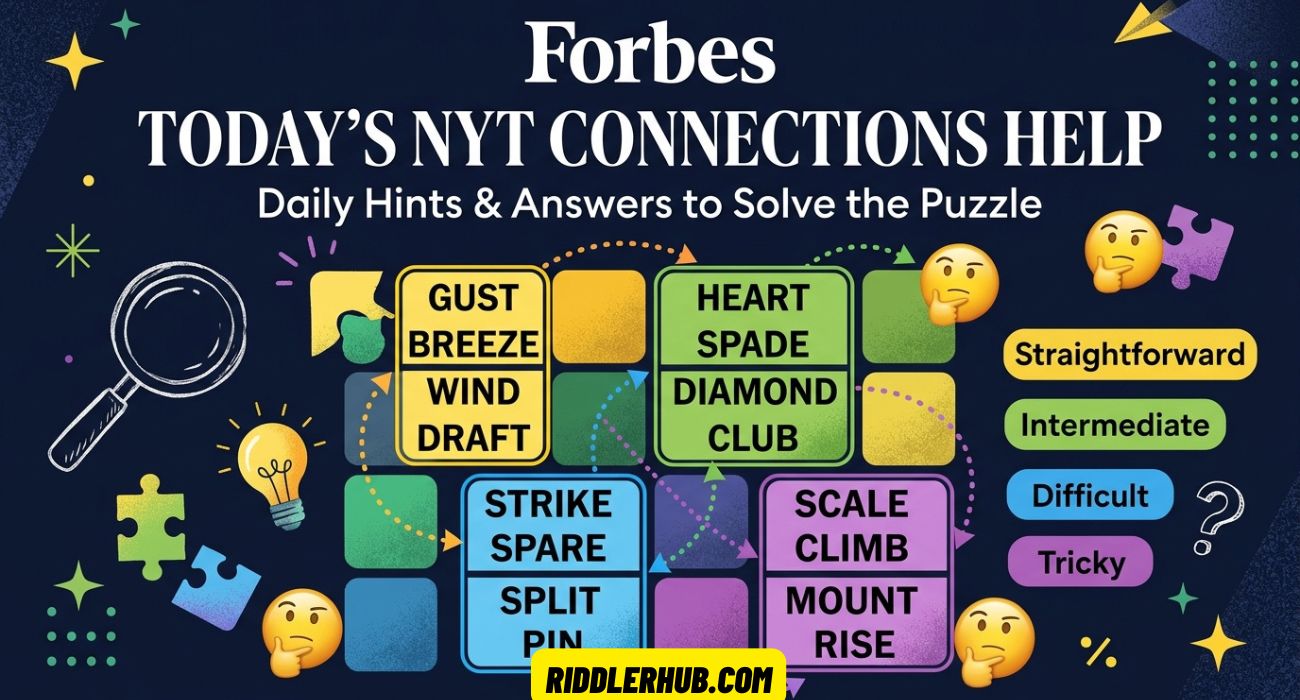
- The colors indicate the intended difficulty order: yellow, green, blue, then purple.
The important lesson is that not every apparent relationship is correct.
How Forbes Covers the NYT Connections Puzzle
A major reason people search for connections hint Forbes is the way the publication structures its daily guides.
Daily Hint Format
A typical Forbes guide starts with the day’s 16 words and then moves gradually toward the solutions.
For example, a guide can present:
- The 16-word list
- A hint for each color group
- One word from each group
- The category names
- The complete answers
- Commentary explaining how the groups fit together
This progression lets readers choose how much help they actually need.
Progressive Clues Without Immediate Spoilers
The progressive approach is particularly useful for players who are stuck on only one group.
Instead of immediately reading the four answers, you can stop after seeing a general clue and return to the puzzle.
That preserves more of the challenge.
Category Reveals
If a broad hint isn’t enough, the next step is often the category itself.
A category such as “skincare products” or “1980s synth-pop bands” makes the intended relationship much clearer than a vague clue. Forbes guides have used this type of category reveal in their daily coverage.
Full Answers and Word Groups
At the bottom of the guide, Forbes provides the complete word groups for readers who want the solution.
This is the most spoiler-heavy section, so players who still want to solve the puzzle themselves should stop earlier.
Puzzle Breakdown and Logic Explained
Forbes also publishes separate “answers explained” pieces for some puzzles. These go beyond simply listing the four groups and discuss why the words belong together and how misleading alternatives can work as red herrings.
That type of explanation can be more valuable than simply seeing the answer.
See Also : Erikkapost com: Complete Guide to Features, Content, Benefits
Why So Many Players Search for “Connections Forbes Today”
The search is driven by a simple problem: the puzzle is designed to make you doubt your first interpretation.
A player may recognize three words that seem related but struggle to find the fourth. Another player may see four plausible words but discover that one belongs to a different group.
A daily Forbes guide can help at several levels:
- A broad clue can get you thinking.
- One example word can confirm a direction.
- A category name can unlock a group.
- The complete answer can show what you missed.
- An explanation can reveal the puzzle’s trick.
This makes a hint guide useful for both casual players and people trying to maintain a daily streak.
Understanding the Four Connections Difficulty Levels
The four colors represent the intended difficulty progression.
| Color | Typical difficulty | What to expect |
|---|---|---|
| 🟨 Yellow | Easiest | Direct or familiar relationship |
| 🟩 Green | Moderate | Less obvious connection |
| 🟦 Blue | Difficult | Specialized or indirect knowledge |
| 🟪 Purple | Hardest | Wordplay or unexpected relationship |
The ordering is intentional, although the actual experience varies from puzzle to puzzle. Forbes describes yellow as the easiest and purple as the hardest, while noting that difficulty can be relative to the individual player.
Yellow: The Easiest Category
Yellow is generally the most accessible group.
These connections may involve straightforward synonyms, common objects, familiar concepts, or recognizable themes.
Don’t assume every yellow group will be obvious, though. A familiar-looking word can still serve as a deliberate distraction.
Green: Slightly More Challenging
Green groups usually require a little more thought.
The relationship may involve a particular context, phrase, category, or secondary meaning rather than a simple synonym.
Blue: Advanced Word Relationships
Blue groups often require broader knowledge or a more specific association.
You might need to recognize:
- A particular era
- A genre
- A profession
- A cultural reference
- A specialized term
- A shared characteristic
Purple: Creative and Unexpected Connections
Purple is where the puzzle often becomes especially tricky.
The relationship may depend on:
- Wordplay
- Prefixes
- Suffixes
- Double meanings
- Spelling
- Phrases
- Unusual associations
Purple is also where players are most likely to experience a satisfying “aha” moment.
The Most Common Category Types in NYT Connections
Understanding recurring category patterns can make solving much easier.
Synonyms and Similar Meanings
Words can be grouped because they share a meaning or belong to a similar semantic field.
For example, several words might describe speed, size, emotion, movement, or appearance.
Pop Culture References
A group may contain names connected to:
- Television
- Movies
- Music
- Actors
- Characters
- Games
- Celebrities
These categories can be easy if you’re familiar with the reference and difficult if you’re not.
Idioms and Everyday Expressions
Some groups depend on phrases rather than individual word definitions.
A word may belong because it commonly appears after or before another word in an expression.
Homonyms and Multiple Meanings
A word can have several meanings, and Connections often takes advantage of that.
One term may initially suggest one category while actually belonging to another because of a secondary definition.
Prefixes, Suffixes, and Word Patterns
Some of the hardest groups are based on how words are constructed.
A set may consist of words that can follow the same prefix, begin with the same letters, or create familiar terms when combined with another word.
Proper Nouns and Brand Names
Names of companies, places, products, teams, or organizations can form a group when they share a meaningful characteristic.
Sports, Science, Geography, and History Themes
Specialized knowledge can also appear.
A puzzle might connect terms related to a sport, scientific concept, geographic location, historical period, or other knowledge category.
How to Use Connections Forbes Hints Without Spoiling the Puzzle
The best way to use a hint guide is not to read the entire page at once.
Read Only the General Hint First
Start with the broad category clue.
Give yourself a minute or two to reconsider the remaining words before reading further.
Solve One Group Before Viewing Another
If you are stuck on one category, don’t expose clues for everything else.
Solve the group you understand first and then reassess the remaining 12 words.
Reveal Category Names Only When Needed
A category name provides significantly more information than a general clue.
Treat it as your second level of assistance.
Check Full Answers After Finishing
If you’ve already completed the puzzle, reading the full answer list can help you understand any group that felt uncertain.
If you haven’t completed it, the full answers remove much of the challenge.
Review the Explanation to Improve Future Performance
An explanation can teach you how the puzzle was constructed.
If you repeatedly miss wordplay-based categories, studying those explanations can help you recognize similar patterns in future puzzles.
Proven Strategies to Solve NYT Connections Faster
Identify the Most Obvious Group First
Start with the four words that appear to have the strongest relationship.
Don’t immediately submit them, however. Ask yourself whether a fifth word could plausibly fit.
Look Beyond Literal Meanings
If a word doesn’t fit naturally, consider another meaning.
A term that appears to describe an object may actually refer to a person, phrase, title, brand, action, or characteristic.
Watch for Intentional Misdirection
Red herrings are central to the game’s difficulty.
You may see four words that share a broad theme, but one of them is intended for another group.
Forbes’ puzzle explanations frequently point out these kinds of traps.
Group Words by Theme
Mentally sort the words into broad buckets:
- People
- Places
- Objects
- Actions
- Colors
- Food
- Media
- Sports
- Technology
- Expressions
Then look for more precise relationships inside each bucket.
Eliminate Impossible Matches
Don’t only ask, “What belongs together?”
Ask, “What definitely doesn’t belong together?”
Removing impossible combinations can shrink the puzzle dramatically.
Save the Hardest Words for Last
Once one or two groups disappear, the remaining words become easier to analyze.
This is particularly useful when several words initially seem interchangeable.
Think About Context Instead of Definitions
Connections is not always a dictionary test.
Ask where you might encounter the word:
- In a movie?
- On a menu?
- In sports?
- In a song?
- On a computer?
- In an idiom?
- As part of a proper name?
Context can reveal the intended relationship.
See Also : Erikkapost com: Exploring Its Content, Categories
A Better Way to Read a Connections Hint
A hint is most useful when you treat it as a direction rather than an answer.
Suppose a clue suggests that a group relates to “things found in a kitchen.” Don’t immediately search for four objects. Instead, examine every word and ask whether each could describe something in that environment.
Then test the strongest four against the remaining words.
This approach keeps the puzzle-solving element intact while reducing frustration.
How to Tell When Four Words Really Belong Together
Before submitting a group, use a quick three-question test:
1. Is the relationship specific?
Four words being vaguely related isn’t enough.
2. Can all four be explained using the same rule?
The connection should work consistently.
3. Does removing one word make another group stronger?
If so, your original group may contain a red herring.
This simple check can prevent many avoidable mistakes.
Common Mistakes That Cost Players the Puzzle
Several habits repeatedly cause problems.
Submitting a group too quickly: Four related words aren’t necessarily the intended four.
Ignoring alternative meanings: A word can be deliberately misleading.
Focusing on only one interpretation: Consider phrases, names, abbreviations, and word construction.
Overthinking obvious categories: Not every yellow group requires complicated reasoning.
Chasing obscure possibilities: If your theory requires an extremely unlikely connection, reconsider it.
Using hints too aggressively: Reading the complete answer before thinking can prevent you from learning the puzzle’s logic.
Why Playing NYT Connections Every Day Makes You Better
Regular play helps you become familiar with the types of relationships the puzzle uses.
Over time, you may become quicker at recognizing:
- Common category structures
- Wordplay
- Cultural references
- Multiple meanings
- Phrase completions
- Red herrings
- Spelling patterns
You also develop a better sense of when a proposed category is too broad.
The biggest improvement often comes from learning to test a theory before committing to it.
Where to Find Daily Connections Hints and Answers
Players can find daily help from several sources.
The New York Times is the original home of the game and provides the puzzle itself.
Forbes publishes recurring Connections hint and answer guides, including progressive clues and complete solutions.
Other puzzle publications and gaming sites also publish daily guides, but the quality and spoiler structure can vary.
If your goal is to preserve the challenge, look for a guide that separates hints from the final answers.
Can You Play Previous NYT Connections Puzzles?
Yes, access to previous puzzles depends on the version of the NYT Games experience and your subscription.
Forbes’ coverage notes that NYT subscribers can access the Connections archive, which contains older games.
An archive is useful for practice because older puzzles let you experiment without worrying about the current day’s result.
Tips for Beginners Who Want to Improve Quickly
If you’re new to Connections, don’t worry about solving every puzzle perfectly.
Try this routine:
- Scan all 16 words before making a guess.
- Find the most obvious relationship.
- Look for a fourth word that fits precisely.
- Check whether another word could replace it.
- Submit only when the connection is convincing.
- Use one hint if you’re genuinely stuck.
- Study the explanation after finishing.
Most importantly, don’t measure progress only by winning.
Learning why you missed a category is often more valuable than getting lucky.
Connections vs. Wordle vs. Strands vs. Mini Crossword
These New York Times games exercise different skills.
| Game | Main challenge | Typical solving skill |
|---|---|---|
| Connections | Find four related groups | Association and deduction |
| Wordle | Find one five-letter word | Vocabulary and pattern recognition |
| Strands | Find themed words in a letter grid | Word discovery and theme recognition |
| Mini Crossword | Solve short crossword clues | General knowledge and vocabulary |
Connections stands out because the challenge isn’t finding a single answer. You’re solving four related problems while simultaneously avoiding misleading relationships.
How to Build a Daily Connections Routine
A consistent routine can make the puzzle more enjoyable and improve your solving process.
Start Without Outside Help
Give yourself several minutes to inspect the full grid.
Use Hints Strategically
If you’re stuck, use a general clue rather than jumping straight to the solution.
Record Why You Missed
After the puzzle, identify the mistake:
- Wrong association?
- Missed definition?
- Didn’t recognize a reference?
- Overlooked wordplay?
- Fell for a red herring?
Practice Older Puzzles
Older games provide a low-pressure way to build pattern recognition.
Avoid Chasing Speed at First
Accuracy and understanding matter more than solving in the shortest possible time.
Frequently Asked Questions About Connections Forbes
What does Connections Forbes mean?
“Connections Forbes” usually refers to Forbes’ daily coverage of the New York Times Connections puzzle, including hints, category clues, answers, and explanations.
Does Forbes create the NYT Connections puzzle?
No. The New York Times creates and publishes Connections. Forbes provides editorial coverage and guides that help readers solve the daily puzzle.
Are Forbes hints spoiler-free?
They can be used in a relatively spoiler-controlled way because the guides generally progress from the word list to hints, then individual answers, categories, and full solutions. However, once you continue down the page, spoilers become increasingly direct.
What do the Yellow, Green, Blue, and Purple groups represent?
They represent the puzzle’s intended difficulty progression:
- Yellow — easiest
- Green — next
- Blue — harder
- Purple — hardest
The actual difficulty can vary depending on your knowledge and the particular puzzle.
Where can I play NYT Connections?
You can play NYT Connections through the New York Times Games website or NYT Games app. Forbes’ guides identify both as ways to access the game.
Can I play older Connections puzzles?
Yes, eligible NYT subscribers can access the Connections archive, according to Forbes’ game guides.
What time does a new Connections puzzle appear?
The daily puzzle goes live at midnight local time.
Is there a strategy that works for every puzzle?
There is no guaranteed formula because Connections intentionally varies its categories and uses misleading relationships. However, scanning for strong groups, checking alternate meanings, eliminating impossible matches, and watching for red herrings are consistently useful techniques.
Should beginners use hints or solve puzzles independently?
Both approaches are valid. If you’re learning, try solving independently first and use progressively stronger hints only when necessary. Reviewing the explanation afterward can help you improve much faster than simply looking at the final answer.
Final Thoughts on Connections Forbes
Searching for “connections hint Forbes” is essentially a search for a practical way to get help with the daily NYT Connections puzzle without necessarily ruining the experience.
Forbes’ recurring coverage is particularly useful because its hint format can move from broad clues to individual words, categories, and finally complete solutions.
The best approach is to use those hints progressively. Start with the smallest amount of assistance you need, return to the puzzle, and only reveal more if you’re still stuck.
Ultimately, the real value of Connections isn’t just completing today’s grid. It’s learning to recognize relationships, question your first assumptions, spot red herrings, and think about words in more than one way.
Conclusion
Connections Forbes is a useful search term for players looking for daily NYT Connections clues, hints, answers, and explanations. Whether you need one small nudge or the complete solution, a progressive hint format lets you control how much of the puzzle you reveal.
For the best solving experience, start with the general clue, test your own theory, and use the full answer only as a last resort. With regular practice, you’ll become better at recognizing categories, handling misleading words, and finding the connection hiding in plain sight.