
simplifydiggs.com Review: Productivity Tool or Ad-Driven Content Network?
If you searched for simplifydiggs com, you may be wondering whether SimplifyDiggs.com is a productivity application, an automation platform, a technology service, or simply another content website.
The short answer is important: SimplifyDiggs.com appears to function primarily as a general informational website rather than a downloadable productivity application or software utility. Publicly available references describe it as a multi-topic content platform covering areas such as technology, business, finance, automotive, travel, lifestyle, health, gaming, and other general subjects.
That distinction matters because the domain name can create a different expectation. A name containing “simplify” may sound like a software or productivity brand, but a domain should be judged by what it actually provides rather than what its name suggests.
There is also a second issue worth examining: third-party publishing marketplaces currently advertise guest-post and backlink placements associated with the domain. That does not automatically make the website unsafe or fraudulent, but it does mean readers should distinguish between editorial information and potentially commercial content.
So, is SimplifyDiggs useful? Can you trust it? Is it a productivity tool? And is there any evidence that it is a mirror or typo-squatting network?
Let’s break it down.
What Is simplifydiggs.com? Core Purpose and Background
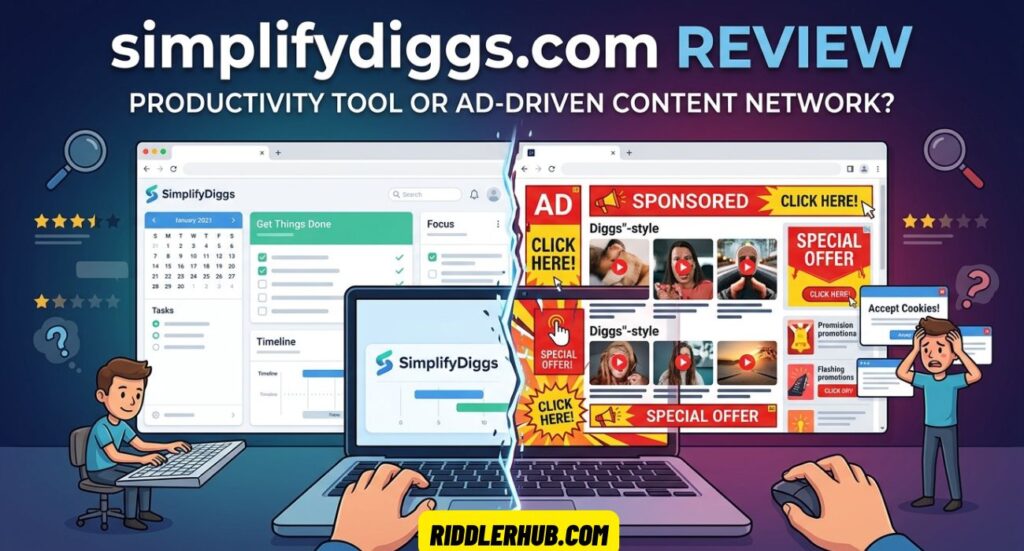
SimplifyDiggs.com appears to be a general-interest content website, not a dedicated software product.
Its content footprint spans numerous categories rather than focusing on one specific subject. That can include technology explainers, business topics, finance-related information, lifestyle articles, travel, automotive subjects, entertainment, gaming, and other web searches.
This makes the website closer to an online magazine or general blog than platforms such as Microsoft 365, Google Workspace, Notion, or Zapier.
A useful way to understand the difference is:
| Website type | Main purpose |
|---|---|
| Productivity application | Helps users complete tasks |
| Automation platform | Connects tools and automates workflows |
| Technology publication | Reports or explains technology |
| General content website | Publishes articles across multiple topics |
| Search directory | Helps users locate services or information |
Based on the available public footprint, SimplifyDiggs fits most closely into the general content website category.
That means visitors should not expect a conventional software dashboard, account-based productivity suite, downloadable desktop application, or automation engine simply because the domain name sounds technology-oriented.
Why Is simplifydiggs.com Getting Attention?
The search query “simplifydiggs com” appears to have an informational intent.
Someone searching the domain name may have:
- Seen SimplifyDiggs in Google search results.
- Clicked one of its articles and wanted to know who operates the site.
- Wondered whether it is a software product.
- Wanted to check whether the website is legitimate.
- Seen the domain mentioned elsewhere.
- Been unsure whether the website is safe.
- Encountered an unfamiliar article and searched the domain before trusting it.
This is common with newer or lesser-known websites. A domain can receive search traffic long before it develops a recognizable brand.
The important point is that search visibility does not automatically equal authority.
A website can rank for informational queries while still having limited editorial transparency, specialist expertise, or original reporting.
Is SimplifyDiggs a Productivity Tool?
The Automation and Software Utility Misconception
There is currently no strong evidence in the public material reviewed that SimplifyDiggs.com is a conventional productivity application comparable to Microsoft 365, Google Workspace, Notion, or Zapier.
A genuine productivity platform normally gives users some combination of:
- An application interface.
- User accounts.
- Task or project management.
- Document creation.
- Collaboration features.
- Automation workflows.
- Integrations.
- Data storage.
- Notifications.
- APIs or developer tools.
- A clear product documentation system.
SimplifyDiggs instead appears primarily associated with published articles and informational content.
This is the most important clarification for people searching for a SimplifyDiggs productivity tool: do not assume that a domain is software simply because its branding sounds like software.
The Mirror Domain and Typo-Squatting Question
Another possible interpretation of the domain is that it could be a mirror, clone, or typo-squatting website.
However, the available evidence does not establish that SimplifyDiggs.com is a confirmed typo-squatting or mirror domain.
Typo-squatting usually involves registering a domain deliberately designed to resemble another established brand. A proper investigation would require identifying the supposed original brand, comparing domain names, checking ownership history, examining redirects, and analyzing the site’s technical and content relationships.
Without that evidence, labeling SimplifyDiggs as a typo-squatting operation would be speculation.
The safer conclusion is:
SimplifyDiggs.com should be evaluated as an unfamiliar content website, not automatically classified as a mirror network.
Does simplifydiggs.com Offer Custom Software or Utilities?
Nothing in the publicly available information reviewed establishes SimplifyDiggs.com as a custom software provider.
If you visit an unfamiliar website expecting a utility, check for practical indicators such as:
- A clearly explained product.
- A features page.
- Documentation.
- Pricing information, if applicable.
- A download or web-app interface.
- User account functionality.
- Privacy and terms pages.
- Support information.
- Developer documentation or API information for technical products.
These signals are more meaningful than the domain name itself.
If your objective is automation, productivity, file management, project management, or collaboration, it is better to use a service whose product purpose is explicitly documented.
For example, Zapier officially describes its platform as an automation system that connects applications and workflows, while Microsoft documents Microsoft 365 as a collection of productivity applications and services. Those are much clearer examples of identifiable software products.
Claim vs. Reality Breakdown
| Question | What the evidence supports |
|---|---|
| Is SimplifyDiggs a software application? | No strong evidence that it is |
| Is it primarily a content website? | Yes, available references consistently describe it that way |
| Is it a productivity suite? | No clear evidence |
| Does the name prove what the site does? | No |
| Is it confirmed malware? | No evidence reviewed establishes this |
| Is it confirmed a typo-squatting network? | No |
| Does it use HTTPS? | HTTPS support has been detected |
| Are there guest-post marketplace listings? | Yes |
| Does a marketplace listing prove every article is paid? | No |
| Should important information be independently verified? | Yes |
The distinction between “not proven dangerous” and “highly trustworthy” is important.
A site does not need to be malicious to deserve cautious evaluation.
Technical Infrastructure and Security Audit
HTTPS and SSL Encryption
Public technical information for the www hostname indicates HTTPS support and an SSL/TLS certificate. The hostname is also shown as using Cloudflare infrastructure.
HTTPS is useful because it encrypts traffic between the browser and the website. It helps protect data while it is being transmitted.
However, HTTPS should not be confused with a trust certificate for the organization behind a website.
A fraudulent or low-quality website can also use HTTPS.
Therefore:
HTTPS = encrypted connection.
It does not automatically mean:
HTTPS = trustworthy publisher.
That distinction is essential when evaluating unfamiliar domains.
WHOIS Privacy and Registration Analysis
A WHOIS review can sometimes reveal useful information such as:
- Domain registration date.
- Registrar.
- Nameservers.
- Registration status.
- Expiration information.
- Ownership visibility.
However, publicly available WHOIS data can be privacy-protected or incomplete. The information available during this review was not sufficient to make a reliable ownership claim about the operator of SimplifyDiggs.com.
That means it would be irresponsible to invent a registration date, owner name, country, or registrar simply to make the review sound more complete.
For users, the practical lesson is simple: lack of easily visible ownership information is a reason to verify important claims, not automatic proof of fraud.
Monetization and User Risk Profile
One of the more interesting signals surrounding SimplifyDiggs is the existence of third-party marketplace listings offering guest-post or backlink placements associated with the domain.
Those listings describe opportunities for publishing content and obtaining dofollow backlinks.
This is relevant because it suggests that the domain has commercial value within the SEO and guest-post ecosystem.
But there is an important limitation:
A third-party marketplace listing does not prove that every article published on SimplifyDiggs is sponsored, paid, or created for backlinks.
It only establishes that external services are advertising publication opportunities involving the domain.
For readers, this creates a reason to look more closely at articles containing:
- Commercial recommendations.
- External business links.
- Promotional language.
- Product claims.
- Affiliate-style calls to action.
- Unusually optimized anchor text.
- Content that appears unrelated to the site’s main audience.
Commercial content is not inherently bad. Transparent commercial relationships are the important issue.
See Also : plusstories.com Review: The Truth Behind Digital Storytelling Claims
Is simplifydiggs.com Safe to Browse?
Based on the technical information available, there is no evidence from this review alone that SimplifyDiggs.com should be classified as a malware site.
HTTPS support is detected, and the website appears to function as a content platform.
However, “safe to browse” should be separated from “safe to trust.”
You can browse a website safely while still questioning whether an article is accurate.
A sensible safety approach
If you visit SimplifyDiggs:
- Keep your browser and operating system updated.
- Do not download unknown files simply because an article recommends them.
- Avoid entering passwords or payment information unless there is a clear reason to do so.
- Check the destination of unfamiliar external links before clicking.
- Treat sensational claims cautiously.
- Verify financial, medical, legal, security, and technical information elsewhere.
- Use reputable software stores rather than random download links.
- Do not assume an advertisement is an editorial recommendation.
This approach applies to almost every unfamiliar website, not just SimplifyDiggs.
Content Quality and Editorial Trust
The biggest question about a broad website like SimplifyDiggs is not necessarily whether the pages load. It is whether the information deserves to be treated as authoritative.
A generalist site covering many unrelated subjects has a difficult editorial challenge.
Technology, finance, automotive, health, travel, and gaming all require different types of knowledge.
A strong publication can cover multiple areas, but readers should expect visible evidence of:
- Qualified authors.
- Clear editorial standards.
- Strong sourcing.
- Expert review where appropriate.
- Original research.
- First-hand experience.
- Transparent corrections.
- Clear ownership.
- Updated information.
If those signals are weak, the content may still be useful as a starting point, but it should not automatically be treated as the final authority.
This is particularly important for YMYL topics—subjects such as health, finance, legal matters, safety, and major purchases where incorrect information can have meaningful consequences.
Pros and Cons of simplifydiggs.com
Pros
- Broad selection of informational topics.
- Easy-to-understand content format.
- Useful for casual browsing and initial research.
- HTTPS support is detected.
- The domain has an established public web footprint.
- Readers can use individual articles as starting points for further research.
Cons
- Broad topic coverage can make specialist expertise difficult to establish.
- The site is not clearly positioned as a dedicated productivity application.
- Public ownership and editorial transparency should be checked carefully.
- Third-party guest-post marketplaces advertise placements involving the domain.
- Commercial relationships may require closer scrutiny on individual pages.
- Content should not automatically be treated as authoritative simply because it ranks in search.
- The homepage was not independently accessible to automated fetching during this review, returning a 403 response.
How to Check Any SimplifyDiggs Article Before Trusting It
You do not have to reject every article on an unfamiliar site.
Instead, evaluate the individual page.
Step 1: Check the author
Look for a meaningful author biography rather than only a name.
Ask:
- Does the writer have relevant expertise?
- Is their professional background explained?
- Do they specialize in the subject?
Step 2: Check the sources
A useful article should make important claims traceable to credible sources.
For technical subjects, look for official documentation.
For finance, look for authoritative financial institutions or primary sources.
For health, look for recognized medical institutions and research.
Step 3: Check the date
Technology changes quickly.
An article that was accurate several years ago may now contain outdated software versions, pricing, security recommendations, or product information.
Step 4: Examine external links
Pay attention to where the article sends you.
A large number of commercial links does not automatically make a page bad, but unexplained promotional links deserve caution.
Step 5: Compare with primary sources
For important decisions, do not stop at one blog.
Compare the information with the official company, product documentation, government source, recognized publication, or other primary authority.
Verified Alternatives for Digital Productivity and Authentic Tech Advice
If your actual goal is productivity, automation, collaboration, or reliable technology information, established platforms are usually a better fit than trying to use a general content site as a software tool.
Verified Productivity and Automation Suites
Microsoft 365 is a comprehensive productivity ecosystem containing products such as Word, Excel, PowerPoint, Outlook, OneDrive, Teams, OneNote, and other services. Microsoft’s documentation clearly identifies these as productivity applications and services.
Google Workspace is another established option for cloud-based collaboration, documents, communication, meetings, and team workflows. Google’s official learning resources describe its collaboration and remote-work capabilities.
Zapier is particularly relevant if your goal is automation. It connects applications through workflows using triggers and actions and supports thousands of application integrations.
These services have a much clearer product identity than a general informational website.
Accredited Technology and News Outlets
For technology news and industry developments, established specialist publications can provide a stronger editorial starting point.
TechCrunch, for example, publishes dedicated coverage across technology, startups, AI, venture capital, transportation, and related areas.
For a specific product, however, the best source is often the manufacturer’s own documentation rather than a news article.
The ideal research hierarchy is:
Official documentation → primary source → established specialist publication → general blog → anonymous or promotional page.
That hierarchy is especially useful when the decision involves money, security, health, or business operations.
See Also ; Mashable Connections Hint Today: Complete NYT Connections Guide 2026
Why “Safe” and “Reliable” Are Different
This distinction deserves its own section because it is one of the most common misunderstandings in website reviews.
A website can be:
- Safe to open but inaccurate.
- Accurate in some articles but commercially motivated.
- Legitimate but poorly maintained.
- Securely encrypted but editorially weak.
- Useful for general information but unsuitable for professional decisions.
Therefore, asking only “Is simplifydiggs.com safe?” does not give you the complete answer.
A better question is:
“Is this particular SimplifyDiggs article sufficiently trustworthy for the decision I am about to make?”
That question leads to a much better evaluation.
Frequently Asked Questions
Is simplifydiggs.com a downloadable software tool?
There is no strong evidence in the information reviewed that SimplifyDiggs.com is a conventional downloadable productivity application. It appears primarily to operate as an informational/content website.
Is simplifydiggs.com a productivity platform?
It should not be confused with a dedicated productivity platform such as Microsoft 365, Google Workspace, or an automation service such as Zapier. Its public footprint is primarily associated with published informational content.
Is simplifydiggs.com safe?
There is no evidence from this review alone that the domain is malware or a confirmed scam. HTTPS support is detected. Nevertheless, users should still exercise normal caution with downloads, external links, account credentials, and payment information.
Is simplifydiggs.com legitimate?
The domain has a functioning public web presence and is referenced by third-party publishing marketplaces. That does not establish that every article is authoritative or that every commercial relationship is transparent. Legitimacy and editorial reliability are separate questions.
Is simplifydiggs.com a mirror website?
There is not enough evidence to conclusively classify the domain as a mirror website. The available evidence is more consistent with a general multi-topic content site.
Is simplifydiggs.com a typo-squatting domain?
No reliable evidence reviewed confirms that classification. A typo-squatting claim requires identifying the original brand being impersonated and demonstrating a deliberate domain similarity or deceptive relationship.
Are domain variations like “mysimplifydiggs” safe?
Do not assume that a domain variation belongs to the same operator.
A domain such as “mysimplifydiggs” should be evaluated independently. Check:
- The exact spelling.
- HTTPS.
- Domain age and registration information.
- Redirect behavior.
- Site ownership information.
- Download prompts.
- Privacy policies.
- Contact information.
- Whether it impersonates another company.
A similar-looking domain can be completely unrelated to the original.
Should I download software recommended by SimplifyDiggs?
Do not download software solely because a blog recommends it. Visit the software developer’s official website or a reputable app store and verify the application’s publisher before installing anything.
Can I trust SimplifyDiggs for financial or medical advice?
It is better to use SimplifyDiggs, or any broad general-interest blog, as an initial source rather than your final authority for high-stakes subjects. Verify financial and medical claims with authoritative sources and qualified professionals where appropriate.
Does SimplifyDiggs accept guest posts?
Third-party publishing marketplaces currently advertise guest-post and link-placement opportunities involving the domain. That establishes the existence of marketplace offers, but it does not prove that every article on the site is paid or sponsored.
Why does SimplifyDiggs appear in Google searches?
A broad content website can rank for many informational queries. Search visibility alone does not establish expertise, accuracy, or editorial authority.
What are the best alternatives to SimplifyDiggs for productivity?
For actual productivity and automation, consider established platforms such as Microsoft 365, Google Workspace, and Zapier. For technology news, use established specialist publications and, whenever possible, verify product claims against official documentation.
Final Words
The simplest way to understand simplifydiggs com is this: it appears to be a broad informational content website, not a dedicated productivity application or software utility.
The available evidence does not justify calling it a confirmed mirror network, typo-squatting operation, or malware site. At the same time, there is no reason to treat the domain as an unquestionable authority simply because its pages appear in search results.
The technical picture is relatively straightforward. HTTPS support is detected, while public technical information associates the www hostname with Cloudflare infrastructure. The more important questions are editorial rather than purely technical.
Third-party publishing marketplaces advertise guest-post and backlink placements associated with SimplifyDiggs. That is worth knowing because commercial publishing can influence how readers should interpret some pages, although a marketplace listing alone does not prove that every article is paid or promotional.
For casual research, SimplifyDiggs may provide useful starting points. For important decisions, however, use the site as one source among several and verify claims against primary or specialist sources.