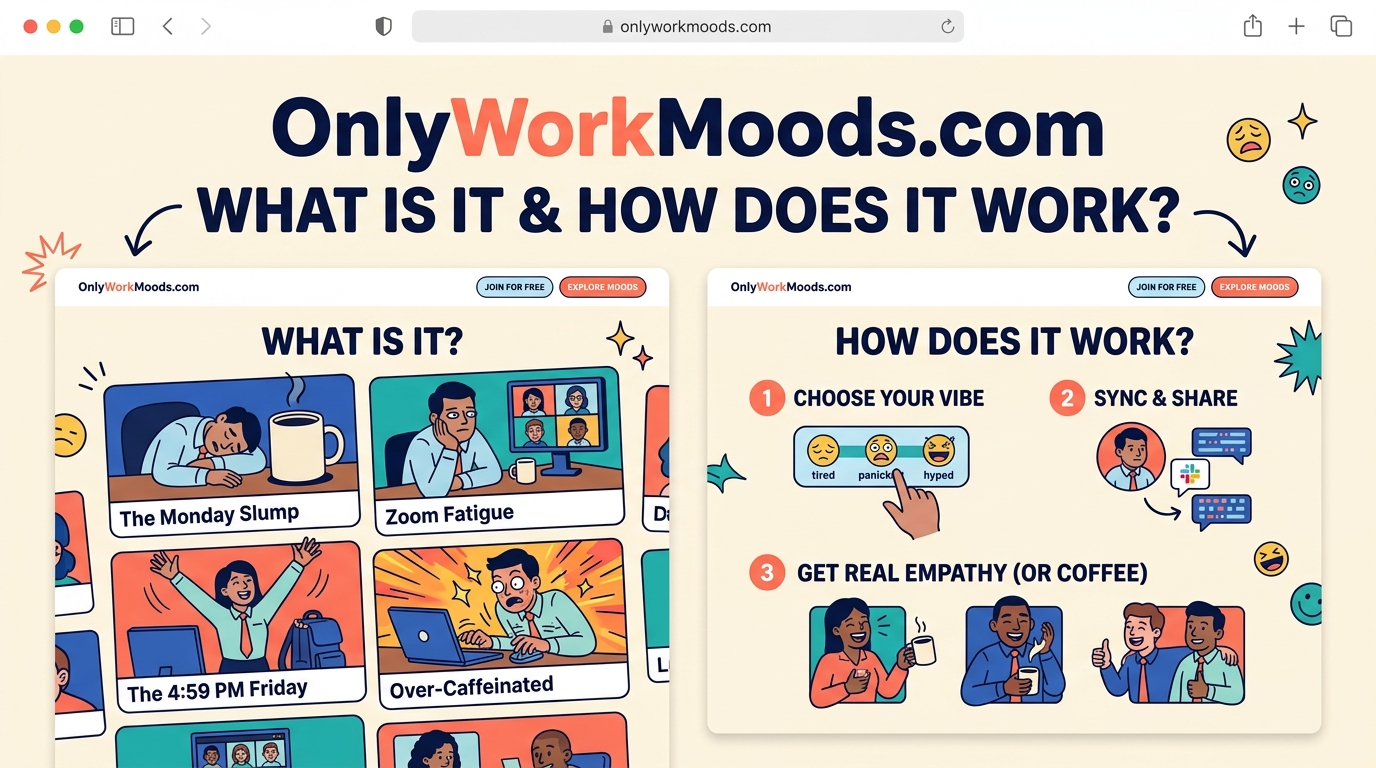
OnlyWorkMoods.com: What Is It and How Does It Work?
If you searched for onlyworkmoods com, you may be wondering whether you have found a productivity tool, workplace mood tracker, career platform, or something else entirely. The name sounds like it could describe software built around work habits and employee wellbeing, but the website’s apparent function is much simpler.
Based on the available public information, OnlyWorkMoods.com is primarily an informational content website rather than a dedicated app or workplace analytics platform. Its subject matter centers around work, careers, productivity, business, money, technology, lifestyle, and related topics.
That distinction matters because the site’s name can create expectations that its actual format does not necessarily meet. If you’re looking for a mood-tracking dashboard or workplace management software, you should not assume those features exist simply because the domain contains the words “work” and “moods.”
This guide explains what OnlyWorkMoods.com appears to be, what readers can find there, how its content is structured, why the exact phrase is being searched, and how to evaluate the information you find.
What Is Onlyworkmoods.com, Actually?
OnlyWorkMoods.com appears to operate as an online publishing platform. Instead of functioning like software that requires users to create profiles, enter data, or manage a dashboard, the site is primarily organized around articles that visitors can browse and read.
Public descriptions of the site associate it with topics such as careers, workplace issues, professional development, productivity, business, finance, technology, and everyday life.
The site’s current branding also uses the broader idea of work, money, and life, which helps explain why its content can extend beyond workplace psychology or productivity alone. Public domain information lists the domain as registered in March 2023 and identifies HTTPS support, although technical details such as domain age should not be confused with editorial credibility.
In practical terms, the visitor experience is closer to that of a blog or digital magazine than a software product:
Search or direct visit → choose an article → read the information → explore related content
There is no need to interpret the name as a technical description. The most useful way to understand the site is to look at what it actually publishes rather than what its domain name might suggest.
What the Site Is Not
The distinction becomes clearer when you compare the site’s apparent purpose with the tools people may associate with its name.
OnlyWorkMoods.com should not automatically be treated as:
- A workplace mood-tracking application
- An employee sentiment dashboard
- HR analytics software
- A productivity management platform
- A task-management application
- A personal mood diary
- A workplace monitoring service
- A downloadable mobile productivity app
Recent examinations of the site similarly describe it as article-based rather than an interactive productivity or mood-tracking service.
The important point is that publishing information about productivity is not the same thing as providing productivity software.
What You’ll Actually Find on the Site
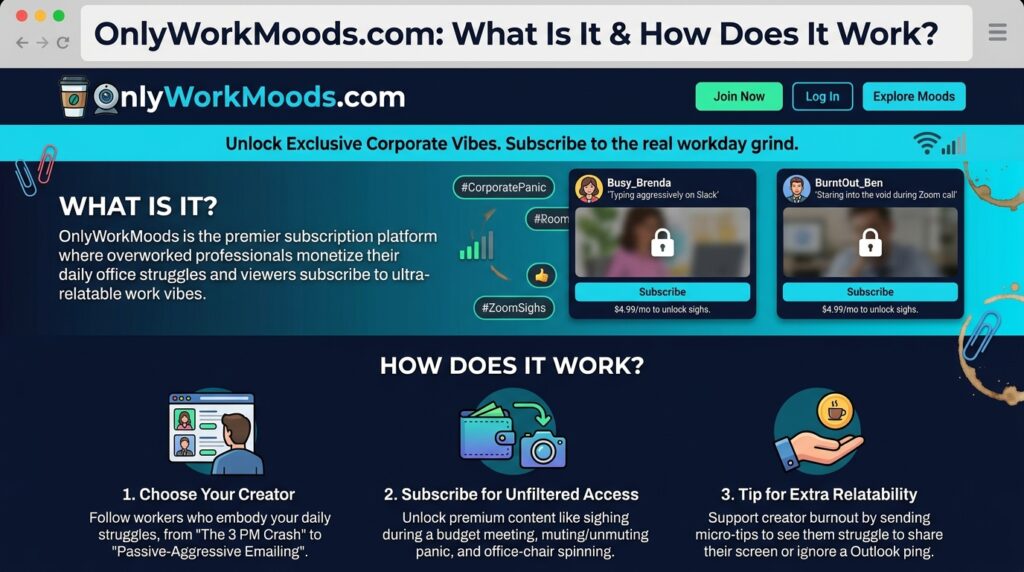
Once you stop expecting a software dashboard, the website becomes easier to understand.
The available descriptions indicate that OnlyWorkMoods.com publishes general-interest articles covering work-related subjects alongside broader topics. Some sources describe its coverage as including careers, productivity, business, finance, technology, lifestyle, education, travel, and other categories.
This broad editorial approach means the site may be useful for casual information discovery, but it also means readers should evaluate individual articles according to their subject and evidence rather than assuming that every page has the same level of expertise.
Content Format
The primary format is written online content.
A typical visitor is likely to encounter:
- Informational articles
- Explainers
- Advice-oriented posts
- Career and workplace discussions
- General-interest guides
- Practical tips and introductory information
The format is straightforward. You generally read an article rather than interact with a specialized tool.
That makes OnlyWorkMoods.com easy to browse, but it also means its value depends heavily on the quality, accuracy, sourcing, and depth of the individual content.
Topic Range
The name suggests a narrowly focused workplace publication, but publicly available descriptions indicate a wider subject range.
Work-related topics can include:
- Careers and professional development
- Job-search advice
- Productivity
- Workplace culture
- Leadership
- Communication
- Remote and hybrid work
- Professional skills
Other content areas may extend into:
- Business
- Personal finance
- Technology
- Education
- Lifestyle
- Travel
- Health-related subjects
- Home and everyday topics
One independent review identified a particularly broad set of categories, including automotive, business, education, fashion, finance, health, lifestyle, technology, travel, home improvement, law, sports, and general topics.
That breadth is worth keeping in mind. Someone searching specifically for workplace expertise may find useful material, but the site is not necessarily equivalent to a specialist publication dedicated exclusively to employment or organizational psychology.
Who’s Behind It?
This is one area where readers should be more cautious.
The publicly available information does not provide the same level of editorial transparency that you would expect from a major professional publication. Independent examinations have noted limited information about authorship, editorial standards, and organizational ownership.
That does not automatically prove that the site’s information is false. It simply makes it harder for a reader to assess the expertise and accountability behind a particular article.
For low-stakes topics, that may be a relatively minor issue. For important financial, legal, medical, employment, or career decisions, it becomes much more significant.
Why So Many People Are Searching This Exact Phrase
The search query “onlyworkmoods com” is interesting because it looks like a navigation query.
Someone who searches a complete domain name is often trying to answer one of a few basic questions:
- What is this website?
- Is it a real website?
- What does it actually do?
- Is it an app or tool?
- Can I trust the information?
- Why did I see this name somewhere else?
The unusual domain name probably contributes to the confusion. “OnlyWorkMoods” sounds like a specialized product focused on workplace emotions, productivity, or employee wellbeing.
Search results also contribute to the uncertainty because third-party pages do not always describe the site in exactly the same way. For example, one automated website summary has described OnlyWorkMoods in terms of curated work playlists, while other recent examinations describe it as a general informational publication.
That inconsistency is a useful reminder: a search-result description is not necessarily the same thing as verified information from the website itself.
How the Site Is Structured
OnlyWorkMoods.com appears to use a conventional content-publication structure.
Instead of giving users a single application interface, the site organizes information into articles and broader topical areas.
A simplified user journey looks like this:
Homepage or search result → topic/category → article → related content
This structure is common among content websites because it allows a single domain to target many different searches.
For example, one visitor may arrive because they want career advice, while another may be looking for a technology explanation. Both can potentially land on the same publication even though their search intent is completely different.
The broad structure can therefore be useful for discovery, but it also creates an important question: how closely does each individual article match the site’s stated focus?
That is something readers should judge page by page.
Is OnlyWorkMoods.com Trustworthy?
There is no useful one-word answer to this question.
A website can be real and accessible without every article being authoritative. Likewise, the absence of a large editorial team does not automatically make every article incorrect.
The better approach is to separate technical legitimacy from content credibility.
Public domain information indicates that OnlyWorkMoods.com has an established domain history and HTTPS support. A third-party security assessment also reports positive technical signals.
Those facts can tell you something about the website’s technical presence. They cannot prove that a particular article is fact-checked, professionally reviewed, or suitable for making an important decision.
Technical Safety vs. Information Quality
These are two different questions:
| Question | What it tells you |
|---|---|
| Does the website exist? | Whether the domain has a functioning public presence |
| Does it use HTTPS? | Whether the connection is encrypted |
| Is the domain established? | Provides historical context |
| Does an article cite sources? | Helps assess its evidence |
| Is the author identifiable? | Helps evaluate expertise and accountability |
| Is information current? | Helps determine whether it remains applicable |
| Is the advice appropriate for your situation? | Determines whether you should act on it |
A secure connection does not make an article accurate.
Similarly, a website appearing in Google does not mean Google has independently verified every statement on that website.
What Makes a Content Website Useful?
A site like OnlyWorkMoods.com can still have value even if it isn’t an authoritative source for every subject.
The main benefit is information discovery.
A well-written article can help you:
- Understand an unfamiliar concept
- Discover terminology you did not know
- Generate ideas for further research
- Learn basic background information
- Find questions you should investigate
- Get a general overview of a topic
The key is to match the source to the importance of the decision.
Reading an introductory article about productivity is very different from relying on an article to determine how to handle an employment dispute, investment, medical issue, or legal obligation.
Is It Actually Useful? Pros and Cons
Like many broad content websites, OnlyWorkMoods.com has both potential advantages and limitations.
What It Does Reasonably Well
Accessible information: Articles can be easier to understand than highly technical publications.
Broad coverage: The site can expose readers to several categories, including work, business, technology, finance, and lifestyle.
Easy browsing: Readers who enjoy discovering related topics can move from one article to another without using specialized software.
Useful starting points: General articles can help readers understand what they should research next.
Where It Falls Short
Limited specialization: A broad multi-topic site cannot necessarily provide the same depth as a dedicated career, financial, legal, or technical publication.
Uneven authority: Different subjects require different levels of expertise.
Authorship questions: Public examinations have raised concerns about limited author and editorial transparency.
Potentially broad content strategy: A site covering many unrelated subjects may prioritize search visibility and breadth rather than deep subject-matter specialization.
Not a professional decision-making system: The site should not be confused with a workplace analytics product, HR platform, or specialized professional service.
See Also : JoinCRS.com: Features, Uses, Benefits & Complete Guide
What About the Site’s Ownership and Editorial Transparency?
When evaluating an unfamiliar website, one of the most useful checks is to look beyond the homepage.
Ask:
- Is there a clearly identified publisher?
- Are article authors named?
- Do authors have relevant credentials?
- Is there an editorial policy?
- Are sources cited?
- Is there a corrections policy?
- Is there a meaningful contact page?
- Are claims supported by primary sources?
Independent reviews have pointed to relatively limited transparency around the people and editorial operation behind OnlyWorkMoods.com.
That does not settle whether the site is “good” or “bad.” Instead, it tells you how carefully you should evaluate individual claims.
For a casual article, the threshold may be relatively low. For high-stakes information, it should be much higher.
The Mistake Most Visitors Make
The biggest mistake is judging the site by its name alone.
“OnlyWorkMoods” naturally creates an expectation of a workplace mood or productivity platform.
A visitor might therefore expect:
- Mood tracking
- Productivity statistics
- Employee wellness monitoring
- Workplace dashboards
- Personalized recommendations
- Task management
- Team analytics
But publicly available information instead points primarily toward an article-based content website.
The second common mistake is assuming that because several websites repeat the same description, the description must be verified.
It isn’t.
Online content often gets copied, summarized, or rewritten. Repetition can create an illusion of independent confirmation even when multiple articles are ultimately based on the same assumption.
How to Get Real Value From a Site Like This
The smartest way to use a broad information website is as a research starting point.
Instead of asking, “Can I trust this entire website?”, ask a more useful question:
“Is this particular article supported well enough for what I need?”
Read With a Specific Question in Mind
Start with a clear purpose.
For example, instead of casually browsing “career advice,” you might be trying to answer:
What skills should I improve before applying for a remote position?
A focused question makes it easier to distinguish useful information from generic advice.
Verify Any Practical Advice Elsewhere Before Acting On It
If an article discusses something consequential, check it against a stronger source.
For example:
- Employment questions: Check official government or labor resources.
- Legal questions: Consult applicable laws or qualified legal professionals.
- Financial decisions: Check regulators, financial institutions, or qualified advisers.
- Health questions: Use reputable medical organizations and healthcare professionals.
- Technology questions: Check official documentation from the relevant provider.
The more serious the consequence, the more important independent verification becomes.
Treat It as a Starting Point, Not a Destination
A good informational article should sometimes lead you to better questions.
Think of the process as:
Discover → Understand → Verify → Decide
Not:
Read one article → Assume it is definitive → Act
That approach is useful with virtually any broad online publication.
How to Tell Whether an Individual Article Is Worth Reading
You can perform a quick quality check before spending much time on an article.
Check the Author
Is there a real author name? Does the person have relevant expertise?
Check the Date
Information about technology, employment, finance, and regulations can change quickly.
Check the Sources
Are claims supported by official documents, research, recognized organizations, or primary sources?
Check the Specificity
Strong informational content generally explains why something is true rather than simply making a series of broad claims.
Check for Overpromising
Be cautious when an article presents an easy answer to a complicated problem or makes strong claims without evidence.
These checks are more meaningful than judging a site based solely on its domain name or appearance.
See Also : PixelSpinX.com Overview: What It Offers & How It Works
A Realistic Example of How Someone Might Use It
Imagine someone is considering a career change and searches for information about improving productivity while working remotely.
They discover an article on OnlyWorkMoods.com discussing remote-work habits.
A sensible approach would be:
Step 1: Read the article to understand the basic ideas.
Step 2: Identify specific recommendations that seem useful.
Step 3: Separate general advice from factual claims.
Step 4: Verify important claims using reputable workplace or professional sources.
Step 5: Adapt the useful ideas to their own situation.
In this scenario, the website is functioning as an information discovery tool, not as a professional career adviser or productivity application.
That is a reasonable and often useful role for a general-interest publication.
OnlyWorkMoods.com vs. a Real Mood-Tracking App
The distinction is easiest to see side by side.
| Feature | OnlyWorkMoods.com | Dedicated mood/productivity app |
|---|---|---|
| Main purpose | Reading information | Tracking or managing user data |
| Articles | Yes | May or may not |
| Mood logging | Not established | Common feature |
| Personal dashboard | Not established | Usually available |
| Productivity tracking | Not established | Often available |
| User account | Not presented as the core experience | Usually required |
| Personalized analytics | Not established | Often available |
| Main user activity | Read and browse | Record, track, analyze, manage |
So if your goal is to read about work, careers, productivity, or related subjects, a content website may be relevant.
If your goal is to track your mood, monitor productivity, or manage workplace data, you need a purpose-built application instead.
Is OnlyWorkMoods.com Free to Use?
The website appears to function as a publicly accessible content platform rather than a subscription-based software service.
That means the basic activity associated with the site is reading its publicly available articles. There is no strong public evidence establishing a paid software tier or subscription product as its core offering.
However, “free to read” should not be confused with “free of commercial incentives.” Content websites can use advertising, affiliate relationships, search traffic, or other forms of monetization.
The presence of monetization alone is not proof that information is unreliable. It is simply another reason to distinguish editorial claims from promotional material.
Does OnlyWorkMoods.com Have an App?
There is no strong public evidence establishing OnlyWorkMoods.com as a dedicated mobile application or software product.
The available descriptions consistently characterize the domain primarily as a website where visitors access written content.
If you encounter a separate application claiming to be officially connected to the site, verify the developer, official website, privacy information, and app-store listing before providing personal information.
What Should You Look for Before Trusting a Website Like This?
A simple evaluation framework can prevent most problems.
1. Identity
Can you clearly determine what the site is?
2. Purpose
Does its actual functionality match what its name or marketing suggests?
3. Ownership
Is the organization or publisher reasonably transparent?
4. Authorship
Can you identify who wrote the content?
5. Evidence
Are important claims supported by credible sources?
6. Freshness
Was the article updated recently enough for the topic?
7. Independence
Is the article educational, promotional, or primarily designed to generate clicks?
8. Consequences
How serious would it be if the information were wrong?
This last question is particularly important. A minor mistake in a lifestyle article and an incorrect claim about employment law do not carry the same risk.
Frequently Asked Questions
Is onlyworkmoods.com a real app or tool?
No strong public evidence establishes OnlyWorkMoods.com as a dedicated app, mood tracker, or productivity-management tool. Available information instead describes it primarily as an article-based website covering work and broader topics.
Do I need to sign up or create an account?
The site is primarily presented as a public content website, so creating a personal account is not presented as the central function. If a particular page asks for personal information, review why it is requesting that information before submitting anything.
Is the content trustworthy or fact-checked?
It is better to evaluate individual articles rather than assume that the entire website has a uniform level of authority. Public examinations have noted limited information about authorship and editorial standards.
For important claims, especially those involving legal, financial, medical, employment, or safety matters, verify the information through authoritative sources.
What’s the difference between this and an actual mood-tracking app?
A mood-tracking app is designed to let users record moods, view patterns, receive personalized insights, or monitor wellbeing over time. OnlyWorkMoods.com appears to function primarily as a content publication where visitors read articles rather than enter and analyze personal mood data.
Is onlyworkmoods.com free to use?
The site’s primary public function is reading online content, rather than using a paid software platform. There is no strong evidence that a subscription-based application is the site’s core product.
Should I rely on onlyworkmoods.com for career or workplace decisions?
It can be used for general ideas and initial research, but it should not be your only source for an important career or workplace decision. Verify consequential claims with authoritative employment resources, official documentation, qualified professionals, or other reputable sources.
Conclusion
OnlyWorkMoods.com is best understood as an informational publishing website, not a workplace mood tracker or productivity application. Its content appears to cover work and career subjects while extending into broader areas such as business, finance, technology, lifestyle, and other general-interest topics.
The unusual name is largely responsible for the confusion. It sounds like specialized software, but the available evidence points toward a conventional article-based website.
That does not make the site automatically useful or useless. The smarter approach is to evaluate each article on its own merits: look at authorship, sources, publication date, specificity, and the consequences of relying on the information.
For casual research and discovering ideas, a site like OnlyWorkMoods.com can be a starting point. For important financial, legal, medical, employment, or professional decisions, use it alongside stronger authoritative sources rather than treating any single article as the final word.