Mashable Connections Hint Today: Complete NYT Connections Guide 2026
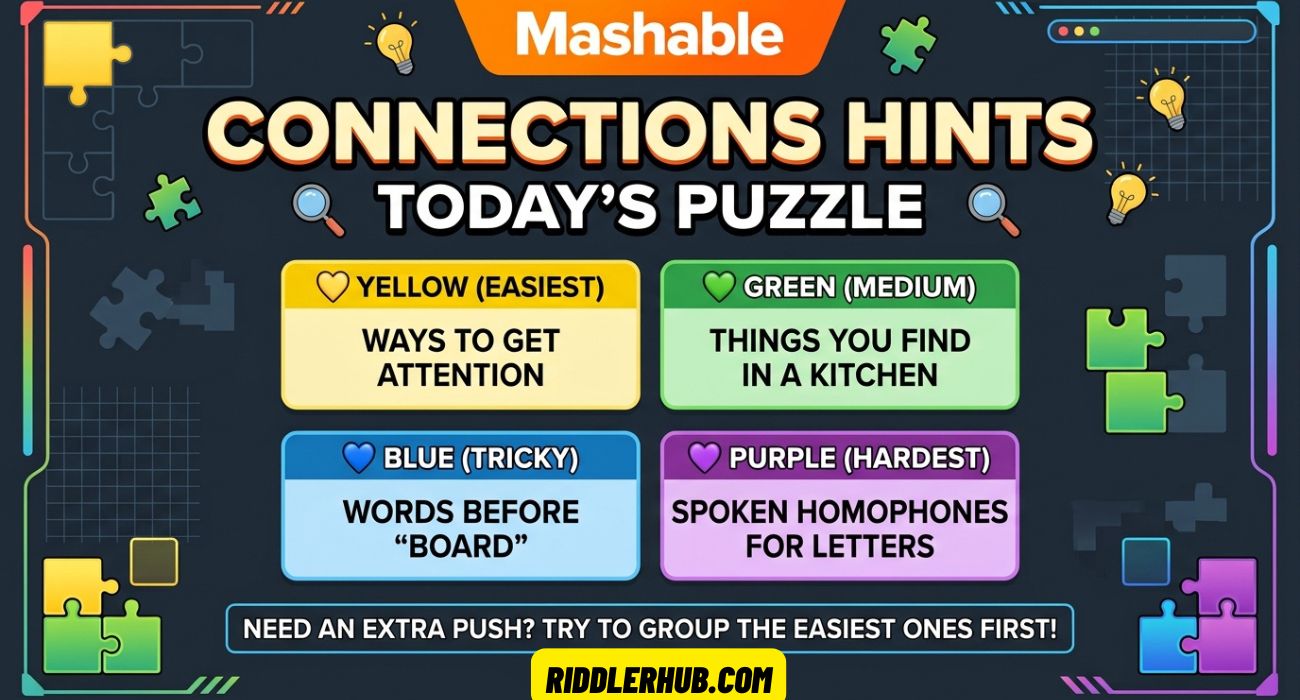
If you’re searching for the Mashable Connections hint today, you’re probably stuck on one of the four categories in the latest NYT Connections puzzle and want a nudge without immediately seeing every answer.
Mashable’s daily Connections coverage is designed around that exact problem: players can look for clues, tips, and eventually the complete solution if they need it.
But hints are most useful when you understand why Connections is difficult. The puzzle gives you 16 words and asks you to divide them into four groups of four. The challenge is that several words can appear to belong together even when only one combination is correct.
This guide explains how the game works, why Mashable-style hints can be useful, and the strategies that can help you solve the daily puzzle with fewer mistakes.
What Is NYT Connections?
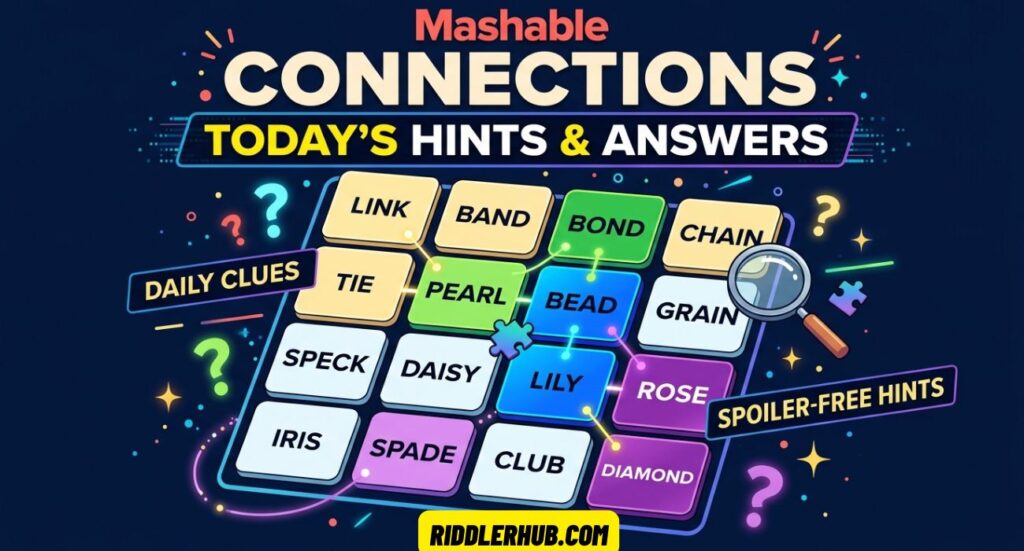
NYT Connections is a daily word-association puzzle from The New York Times.
Each puzzle presents 16 words or terms in a four-by-four grid. Your goal is to organize those 16 entries into four groups of four, with each group connected by a particular idea, category, phrase, wordplay pattern, or other relationship.
The basic concept sounds simple:
- Read all 16 words.
- Find four words that share a connection.
- Submit the group.
- Continue with the remaining words.
- Complete all four categories before using all four mistakes.
The difficulty comes from the fact that the connection is not always obvious. A word can seem to belong to multiple categories, creating deliberate red herrings that can send you toward the wrong answer.
That’s why searching for a Connections hint today can be more helpful than immediately searching for the complete solution.
A good hint gives you another way to look at the board without removing the satisfaction of solving it yourself.
Why Mashable Connections Hint Today Is So Popular
Daily Connections has become part of the broader NYT Games routine alongside puzzles such as Wordle and Strands. Mashable has also published daily Connections hint-and-answer coverage, giving players a way to get assistance when a puzzle becomes difficult.
There are several reasons players specifically look for hints instead of answers.
1. Hints preserve the challenge
Seeing the full solution immediately tells you what the categories are and which words belong to them. A hint can provide just enough direction to trigger the connection yourself.
2. Connections can be deceptively difficult
A group may look obvious because three words clearly match. The fourth word might be less apparent, while another word may look like an equally good candidate.
3. Players want to protect their streak
Because you have a limited number of incorrect guesses, random experimentation can quickly turn a promising puzzle into a loss. Current guides consistently describe the four-mistake limit as an important part of the game’s strategy.
4. The puzzle rewards lateral thinking
Connections isn’t simply a vocabulary test. Categories can involve synonyms, objects, names, phrases, cultural references, word endings, hidden words, homophones, and other forms of wordplay.
That variety is what makes the daily puzzle different from simply finding four synonyms.
How NYT Connections Puzzle Works
The basic rules are straightforward.
You start with 16 entries and need to identify four groups of four. Every entry belongs to one final group.
When you select four entries and submit them, the game tells you whether the group is correct. A successful group is removed from the board, while an incorrect submission costs one of your available mistakes. Players can make up to four mistakes before the puzzle ends.
The important part is this:
A connection must work for all four words, not merely for two or three of them.
For example, imagine you notice that four words could all relate to sports. Before submitting, ask whether there is a more precise relationship connecting exactly those four words.
Connections often rewards the narrower interpretation.
Difficulty Colors
The four categories have different difficulty levels:
| Color | General Difficulty | What to Expect |
|---|---|---|
| 🟨 Yellow | Easiest | Direct or familiar relationship |
| 🟩 Green | Moderate | Requires more interpretation |
| 🟦 Blue | Hard | Less obvious association or knowledge |
| 🟪 Purple | Hardest | Often involves wordplay or an unusual pattern |
Yellow is generally the most straightforward category, while purple is intended to be the most difficult.
The colors aren’t necessarily instructions telling you which group you must solve first. They are difficulty classifications. In practice, however, identifying an obvious yellow group can remove four distracting words and make the remaining puzzle easier.
Why You Get Stuck in Connections
Getting stuck doesn’t necessarily mean you don’t know enough words.
Often, the puzzle is doing exactly what it was designed to do.
Ambiguous words
Some entries have several meanings. A word might describe an object, a person, an action, and part of a familiar phrase.
Overlapping categories
You may find five words that appear to fit the same theme. Since only four can belong to that category, at least one is probably a trap.
Unusual category definitions
Connections doesn’t always use categories such as “types of fruit” or “animals.”
The relationship may instead be:
- Words that follow a particular term
- Words that can precede another word
- Names of fictional characters
- Words with a hidden abbreviation
- Homophones
- Words containing another word
- Different meanings of the same expression
- Titles or proper names
- Common phrases
Purple-category wordplay
The hardest category frequently depends on a connection that isn’t visible from ordinary definitions. That is why purple can feel impossible until one small insight makes all four words suddenly click.
See Also : SFM Compile Meaning: What It Is, How It Works, and How to Compile
What Makes a Mashable Connections Guide Useful?
The biggest value of a daily Connections guide is progressive assistance.
Instead of immediately giving yourself all four answers, you can use a hint to identify the direction of a category.
A useful hint sequence might look like this:
Level 1: General clue
You learn the broad subject.
Level 2: Stronger clue
The relationship becomes easier to recognize.
Level 3: Category identification
You understand what connects the four entries.
Level 4: Full answer
You see the exact words.
This approach is particularly useful if you care about maintaining a streak while still solving the puzzle yourself.
Mashable’s daily coverage similarly presents hints and tips before the complete solution, allowing readers to decide how much help they want.
Smart Strategy to Solve NYT Connections Faster
The best Connections strategy isn’t simply “find four words that look related.”
Instead, treat the board as a classification problem.
Start With Obvious Groups
Scan the entire grid before making your first selection.
Look for four entries that have an unusually strong relationship.
For example, if four words clearly represent the same type of object and no fifth word seems to fit, that may be your safest starting point.
Don’t submit just because you found four words that could work.
Ask:
“Can I explain exactly why these four belong together?”
If you can, your confidence is much higher.
Focus on Category Thinking
Don’t examine every word in isolation.
Instead, ask what category could contain several of them.
For example:
- Are several words foods?
- Are several words names?
- Could some complete the same phrase?
- Could some be preceded by the same word?
- Do several have another meaning?
- Are some related through spelling rather than meaning?
The goal is to move from word recognition to relationship recognition.
Use Elimination Method
Once you solve one group, four words disappear from consideration.
That changes the puzzle dramatically.
Suppose the original board has 16 entries and you correctly remove four. You now have only 12 words to analyze.
After a second successful group, you’re down to eight.
After three groups, the final four automatically form the remaining category.
This is why solving a strong, reliable group early can be more valuable than spending several minutes trying to crack the hardest category.
Watch for Trap Words
A trap word is an entry that seems to belong to a category but actually belongs somewhere else.
Imagine you find these five apparent candidates:
A — B — C — D — E
If the category needs four words, don’t simply choose the four that look most similar.
Instead, investigate why each one might have been included.
The fifth word may be the key to another category.
This is one of the central ideas behind Connections: words that appear interchangeable often aren’t.
Think in Patterns, Not Words
Experienced players often stop asking:
“What does this word mean?”
and start asking:
“What relationship could these four words share?”
That shift matters.
A word may have an ordinary dictionary definition, but Connections could be using:
- Its sound
- Its spelling
- A second definition
- A common phrase
- A title
- A name
- A prefix or suffix
- A hidden sequence
The board becomes much easier when you consider multiple dimensions at once.
Example Breakdown: How Solving Works
Consider a fictional Connections-style board containing 16 entries.
Imagine you notice four words that appear to describe physical objects. At first, they seem like an obvious category.
But one of those words also forms a familiar phrase with another word on the board.
That’s where the puzzle becomes interesting.
Step 1: The “Obvious” Trap
You identify four apparently related words.
Before submitting, you notice that one word has a stronger connection to another possible group.
Instead of guessing, you hold the group back.
This protects one of your limited mistakes.
Step 2: Spotting the Theme Group
You find four words that share a precise theme.
The relationship is stronger because all four fit naturally and there isn’t a convincing fifth candidate.
You submit them.
The group disappears.
Now the board has 12 entries.
Step 3: The Wordplay Group
With fewer words remaining, a strange pattern becomes visible.
Three words appear unrelated by meaning, but each can interact with the same word or phrase.
You recognize that the category isn’t semantic in the traditional sense. It’s based on wordplay.
That is a common way a difficult Connections category can reveal itself.
Step 4: The Purple Finish
Eventually, only four difficult entries remain.
At first, they seem completely unrelated.
Then you notice the shared linguistic pattern.
The purple category clicks into place.
This is one of the most satisfying parts of Connections: a group that looked random can become obvious once you identify the correct interpretation.
See Also : Snapjotz com: What Is Snapjotz and How Does It Work?
Case Study: How One Streak Survived a Brutal Purple Category
Imagine a player has already solved the first three groups without mistakes.
Four words remain.
None appear to share a normal category.
The player considers several possibilities:
- A shared topic
- A shared phrase
- A spelling pattern
- A wordplay relationship
Instead of randomly submitting combinations, they examine the four words from different angles.
One word can be interpreted differently from its most obvious definition.
A second has a familiar alternate meaning.
A third works as part of a phrase.
The fourth follows the same pattern.
The key insight is that the category isn’t about what the words mean individually. It’s about what they do together.
That is exactly the kind of situation where a purple hint can be useful. A small clue about the type of relationship may be enough to finish the puzzle without revealing the complete solution.
Connections Compared to Other NYT Word Games
Connections is part of a broader collection of NYT Games, but its solving method is very different from other popular puzzles.
| Game | Main Challenge | Core Skill |
|---|---|---|
| Connections | Group 16 entries into four categories | Association and pattern recognition |
| Wordle | Find one hidden five-letter word | Vocabulary and deduction |
| Strands | Find themed words in a letter grid | Word search and theme recognition |
| Spelling Bee | Build words from available letters | Vocabulary and word formation |
The important distinction is that Connections is about relationships between entries.
You aren’t trying to identify one correct word.
You’re trying to discover four systems hidden inside the same board.
That makes it especially rewarding for players who enjoy categorization and lateral thinking.
Why Daily Practice Matters
Connections rewards familiarity with the puzzle’s structure.
You don’t necessarily need to memorize previous answers. What matters more is learning how the game tries to mislead you.
Daily practice helps you recognize recurring patterns such as:
- Double meanings
- Common phrase completions
- Categories involving names
- Hidden words
- Homophones
- Word prefixes and suffixes
- Cultural references
- Multiple plausible groups
- Deliberate red herrings
You also become better at judging when a group is strong enough to submit.
That distinction can save mistakes.
A player who practices regularly may start recognizing the difference between:
“These four words are related.”
and
“These four words are almost certainly the intended category.”
The second standard is much more useful.
Common Mistakes to Avoid
1. Submitting too quickly
Finding four related words isn’t enough.
Look for a stronger explanation before using a guess.
2. Assuming the most obvious meaning
Connections frequently relies on alternate meanings.
If a word seems too easy, ask whether it might be doing something else.
3. Ignoring the fifth candidate
If five words appear to fit one category, stop.
The extra word is probably important.
4. Starting with purple
There’s nothing wrong with spotting purple first, but deliberately chasing the hardest category can waste time.
If an obvious group is available, removing it can simplify everything else.
5. Treating categories as broad topics
A category usually needs a precise relationship.
“Things associated with travel” is too broad unless the four words share a much more specific connection.
6. Using all your guesses experimentally
You have limited room for mistakes.
Use each submission as a reasoned test rather than a coin flip.
Advanced Thinking Technique: Build a Candidate Matrix
For harder puzzles, mentally create a small candidate matrix.
For each word, consider several possible relationships:
| Word | Meaning | Phrase | Name/Reference | Wordplay |
|---|---|---|---|---|
| A | ✓ | ✓ | — | — |
| B | ✓ | — | ✓ | — |
| C | — | ✓ | — | ✓ |
| D | — | ✓ | ✓ | — |
You don’t need to physically write this down.
The purpose is to stop yourself from becoming attached to your first interpretation.
A word that appears to belong to one category may have another role.
The strongest group is usually the one where:
- All four words fit naturally.
- The category can be described precisely.
- No fifth word fits equally well.
- The connection isn’t dependent on a vague association.
This method is particularly useful when you’re down to eight or fewer words.
Why Every Puzzle Feels Different
Connections has a consistent structure, but the content changes every day.
One puzzle might depend heavily on vocabulary.
Another may require knowledge of entertainment or popular culture.
A different puzzle may revolve around wordplay.
The changing categories prevent players from simply memorizing one solving formula.
Even the difficulty can feel different from day to day. Some boards give you an obvious yellow group immediately, while others make the first breakthrough much harder.
That’s why searching for a Mashable Connections hint today remains useful even for experienced players.
A player who normally solves Connections quickly can still encounter a board where one category uses an unexpected interpretation.
How to Use a Connections Hint Without Spoiling the Puzzle
If you are stuck, don’t jump straight to the complete answer.
Try this order:
First: Read a broad hint.
Second: Return to the board and look for the suggested theme.
Third: Identify three possible words.
Fourth: Search for the fourth word that makes the category precise.
Fifth: Only check the full answer if you still can’t solve it.
This gives you the benefit of assistance while preserving the actual solving experience.
It’s also a better way to improve. If you see the answer immediately, you learn what the category was. If you work it out after a hint, you learn how to recognize that category next time.
Frequently Asked Questions About Mashable Connections Hint Today
What is the Mashable Connections hint today?
It refers to Mashable’s daily coverage of the current NYT Connections puzzle, which can include clues, tips, and the complete solution. Mashable’s published Connections articles typically provide hints before revealing the final answers.
What is today’s NYT Connections puzzle?
NYT Connections is a daily puzzle in which you sort 16 entries into four groups of four based on hidden relationships. The specific board changes each day.
How many mistakes can you make in Connections?
You can make four mistakes. A wrong submission uses one of those mistakes, so random guessing is risky.
What do the yellow, green, blue, and purple colors mean?
They represent the relative difficulty of the four categories. Yellow is generally the easiest, followed by green, blue, and purple as the hardest.
Should I solve yellow first?
Usually, yes. An obvious yellow category can remove four words and reduce the number of possibilities on the board. However, you should solve whichever category you can identify with the greatest confidence.
Why is purple so difficult?
Purple categories often depend on wordplay, less obvious associations, alternate meanings, phrases, or other patterns that aren’t immediately apparent from the words’ ordinary definitions.
What does “one away” mean in Connections?
It means that three of the four words you selected belong to the same category, while one does not. This can be valuable information because it tells you that you are close to the intended group.
Can one word belong to two Connections categories?
The puzzle is designed so that each word has one final category. However, several words can deliberately appear to fit more than one category, creating red herrings and making the puzzle harder.
Is it better to use a hint or look at the answer?
If you want to improve at Connections, a hint is usually more useful. It gives you information while still requiring you to make the final connection yourself.
How can I get better at NYT Connections?
Read all 16 entries before guessing, identify the strongest group first, look for precise categories, watch for words with multiple meanings, and save uncertain combinations until you have more information.
Final Takeaway
The Mashable Connections hint today search is ultimately about more than finding a quick answer. It reflects a useful way to approach one of the most deceptively challenging daily word puzzles.
NYT Connections gives you 16 entries, four hidden categories, and only a limited number of mistakes. The winning approach is therefore not to guess faster, but to observe better.
Start with the strongest group. Think about categories rather than isolated words. Treat ambiguous entries with suspicion. Use elimination after every successful group, and approach the purple category as a possible wordplay problem rather than assuming it has an obvious theme.
And when you genuinely get stuck, use a hint before revealing the full solution. One good clue can be enough to turn a seemingly impossible board int