
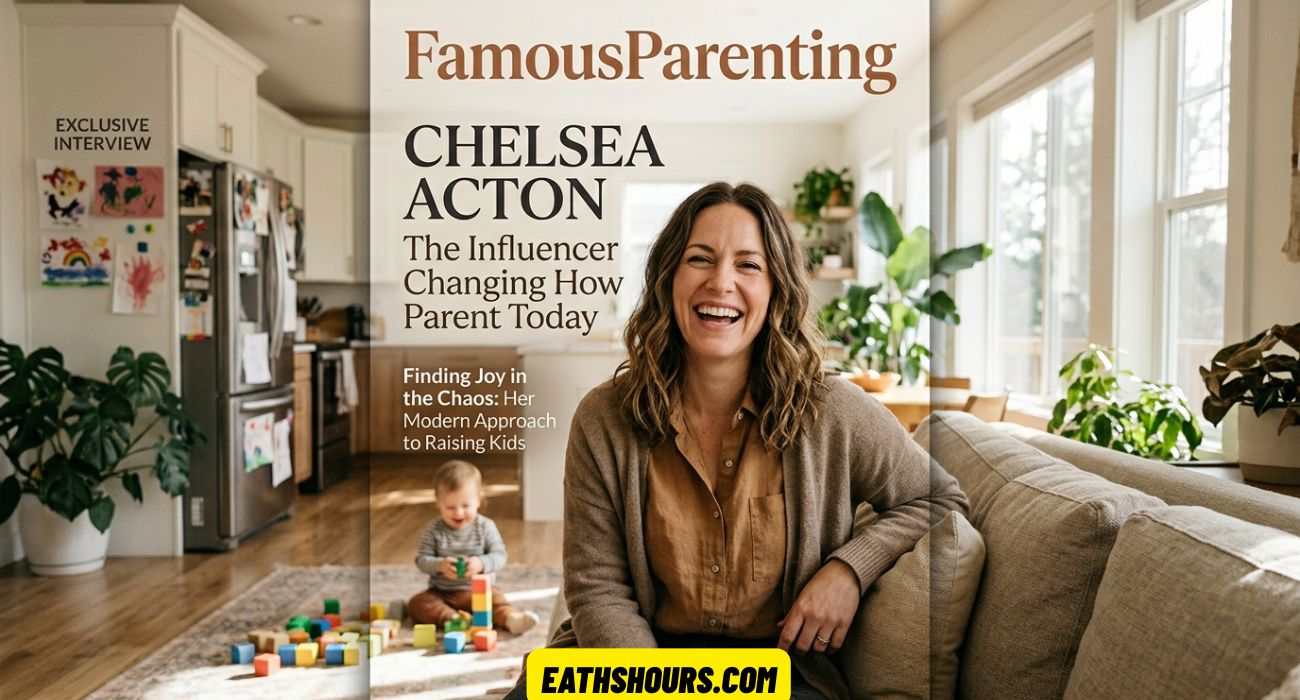
Chelsea Acton FamousParenting: The Influencer Changing How We Parent Today
The search term Chelsea Acton FamousParenting is associated with online discussions about modern parenting, positive discipline, family communication, and raising emotionally confident children. Parents searching for this topic may want to understand who Chelsea Acton is, what the FamousParenting approach represents, and whether its ideas can help with everyday family challenges.
However, an important distinction matters: publicly available information about Chelsea Acton’s biography, professional qualifications, personal life, and alleged book or brand partnerships is limited and inconsistent. Several websites describe her as a parenting influencer, but the details are not sufficiently established to treat every claim as verified fact.
This guide takes a practical, evidence-conscious approach. It explores the parenting principles associated with the Chelsea Acton FamousParenting topic, explains how families can apply similar techniques at home, and identifies what readers should verify before relying on claims about a public figure.
Chelsea Acton Profile Biographie Table
Readers looking for a biography often expect details about a person’s background, education, family, career, and achievements. In Chelsea Acton’s case, those details require caution because reliable independent confirmation is difficult to establish.
| Profile detail | What can responsibly be said |
|---|---|
| Name | Chelsea Acton, as presented in online articles |
| Associated topic | FamousParenting and modern parenting advice |
| Public image | Described by some websites as a parenting influencer or parenting-content creator |
| Main topics associated with the name | Communication, discipline, family routines, and children’s emotional development |
| Education and qualifications | Not independently verified from the sources reviewed |
| Date of birth and age | Not reliably established |
| Family details | Personal details should not be assumed without credible confirmation |
| Published books | A book titled The FamousParenting Method could not be independently verified |
| Official social accounts | No account should be treated as authentic without reliable links or ownership confirmation |
The distinction between a person’s online reputation and a verified biography is important. Repeated claims across articles do not necessarily establish that those claims are true, especially when the websites do not cite primary sources.
For readers, the most useful starting point is to assess the quality of the parenting advice itself rather than assume that every biographical detail published online is accurate.
The Rise of Chelsea Acton and FamousParenting

Parenting content has become a prominent part of the digital information landscape. Families regularly search for guidance on toddler tantrums, bedtime struggles, screen time, sibling conflict, school pressures, and communication with teenagers.
The phrase Chelsea Acton FamousParenting appears in articles that connect the name with these concerns. Some describe an approach centered on empathy, consistent boundaries, and practical routines.
Yet the appearance of a name across multiple websites does not, by itself, prove that the person has a large following, professional influence, or a formally established parenting program.
Why modern parenting advice attracts attention
Several broader trends help explain the appeal of parenting content online:
- Practical solutions: Parents often need strategies they can use during an ordinary, busy day.
- Emotional awareness: Families increasingly seek ways to discuss frustration, anxiety, disappointment, and conflict constructively.
- Positive discipline: Caregivers may prefer approaches that teach responsibility without humiliation or physical punishment.
- Digital challenges: Screen habits, online safety, gaming, and social media create new questions for families.
- Community support: Hearing how other families handle common problems can reduce feelings of isolation.
These are genuine parenting concerns, regardless of whether a particular influencer has a documented connection to them.
A helpful parenting resource should explain not just what parents ought to do, but why a strategy might work, when it may be unsuitable, and how to adapt it to a child’s developmental stage.
What Makes FamousParenting Unique?
The FamousParenting name is associated with accessible parenting content that addresses everyday family situations. Articles discussing Chelsea Acton commonly emphasize empathy, consistent expectations, communication, and routines. However, these themes should be understood as principles associated with the online topic, not as a verified, proprietary method developed by Acton.
Several features make this type of parenting guidance useful when it is explained responsibly.
Advice that can be applied in everyday life
Parents rarely need another list of abstract ideals. They need practical responses to situations such as a child refusing to get dressed, arguing about homework, or struggling to stop playing a video game.
For example, instead of repeatedly telling a child to hurry up, a parent could prepare clothes the night before, give a clear morning instruction, and offer two appropriate choices.
A balance between warmth and boundaries
Supportive parenting does not mean allowing every behavior. Children can be upset about a rule while the rule remains in place.
A parent might say, “I understand that you want another ten minutes of gaming. Screen time is finished for tonight, and you can play again tomorrow.”
The message acknowledges the child’s feelings without abandoning the boundary.
Guidance that respects individual families
No parenting technique works equally well for every child. Age, temperament, disability, developmental needs, cultural expectations, family resources, and daily schedules all affect what is practical.
The best parenting resources help caregivers adapt a strategy instead of presenting one routine as the only correct way to raise a child.
Social Media and Digital Presence
Social media has changed how parents discover advice. Short videos, blog posts, discussion groups, and online communities can make parenting information easy to access, especially for caregivers who cannot attend workshops or seek informal support in person.
Chelsea Acton is discussed in online parenting articles, but a verified list of official social media accounts and independently confirmed audience figures was not established in the sources reviewed. Readers should therefore avoid assuming that every account or page using her name is authentic.
How to evaluate a parenting influencer
Before following or recommending a parenting account, consider these questions:
- Credentials: Does the creator accurately explain their education, training, and professional experience?
- Evidence: Are developmental or medical claims supported by credible research or qualified professionals?
- Transparency: Are paid promotions, affiliate links, and sponsorships clearly disclosed?
- Privacy: Does the creator protect children’s identities and avoid sharing intimate or embarrassing moments?
- Practicality: Does the advice explain how to apply a technique and when it might not work?
- Accountability: Does the creator correct mistakes and distinguish personal opinion from professional guidance?
A polished video or large following is not proof of expertise. Parenting advice deserves the same careful evaluation as other information that can affect a child’s well-being.
Her Book: The FamousParenting Method
Readers searching for The FamousParenting Method may be looking for a book that explains Chelsea Acton’s parenting philosophy in a structured format.
However, I could not independently verify a publication under that exact title with reliable bibliographic information, such as a confirmed author listing, publisher, ISBN, or established bookseller record. It would therefore be misleading to describe the book’s contents, publication date, sales, or reviews as confirmed facts.
How to verify a parenting book
Before purchasing or recommending a book attributed to a public figure, check:
- The publisher’s official catalog.
- The author’s verified website or official account.
- Library catalogs and ISBN databases.
- The book’s publication details and edition information.
- Whether the author has relevant qualifications for any clinical or developmental claims.
If a book cannot be verified, readers can still explore the parenting principles associated with the topic through established resources. The US Centers for Disease Control and Prevention (CDC), for example, provides age-specific positive parenting guidance and practical resources for caregivers.
Parenting Philosophy Breakdown
The Chelsea Acton FamousParenting topic is commonly associated with three broad ideas: encouraging positive behavior, using technology thoughtfully, and maintaining open communication.
These principles can be useful when considered alongside established child-development guidance. The practical recommendations below are general parenting strategies, not verified quotations or personal instructions from Chelsea Acton.
Positive Reinforcement Over Punishment
Positive reinforcement means responding to a behavior in a way that makes the behavior more likely to happen again. For children, this can include specific praise, encouragement, attention, or an age-appropriate reward.
For example, instead of simply saying, “Good job,” when a child tidies their toys, a parent could say, “You put all your building blocks away without being reminded. That was responsible.”
The second response identifies the behavior the parent wants to encourage.
The CDC recommends using positive attention to encourage desirable behavior while applying clear and consistent consequences when necessary.
Practical ways to apply positive reinforcement include:
- Praise effort, cooperation, honesty, and persistence.
- Give instructions that clearly describe the expected behavior.
- Notice small improvements rather than expecting instant perfection.
- Use rewards sparingly when they genuinely help a child learn a new habit.
- Apply reasonable, related consequences when a boundary is crossed.
Positive reinforcement does not eliminate the need for discipline. Effective discipline teaches children what went wrong, what is expected, and how to make a better choice next time.
Technology as a Tool, Not an Enemy
Digital devices can support education, creativity, communication, and entertainment. They can also interfere with sleep, physical activity, schoolwork, and face-to-face relationships when their use becomes unbalanced.
The goal is not necessarily to eliminate screens. It is to help children develop healthy habits that fit their age and circumstances.
The American Academy of Pediatrics recommends a family media plan that considers a child’s developmental stage, the type of content being used, and the family’s daily routines.
| Family challenge | Practical response |
|---|---|
| Arguments about stopping a game | Agree on a stopping time before play begins |
| Phones interrupting meals | Establish a shared screen-free meal rule |
| Late-night scrolling | Charge devices outside bedrooms when appropriate |
| Unsafe online interactions | Discuss privacy, reporting, and trusted adults |
| Excessive passive viewing | Make room for outdoor play, reading, hobbies, and social activities |
Parents should also model the habits they expect from their children. A screen-free dinner rule is easier to understand when adults follow it too.
Communication Is Everything
Open communication helps children learn that they can share feelings, ask questions, and admit mistakes without automatically being shamed.
Good communication involves listening as well as speaking. A parent may need to understand why a child is upset before deciding how to respond.
Consider a child who says, “Nobody at school likes me.”
An unhelpful response might be, “That’s not true. Stop being dramatic.”
A more constructive response could be, “That sounds lonely. Can you tell me what happened today?”
The second response invites conversation without immediately dismissing the child’s experience.
Useful communication habits include:
- Ask open-ended questions instead of interrogating.
- Listen without immediately offering solutions.
- Name emotions in simple, age-appropriate language.
- Explain household rules clearly and calmly.
- Admit mistakes and apologize when appropriate.
- Give teenagers increasing privacy while maintaining reasonable safety boundaries.
Communication is not a guarantee that every disagreement will disappear. Its value lies in creating opportunities for understanding, problem-solving, and rebuilding trust.
See Also : Everything You Need to Know About Trend PBLinuxTech: Features
Parenting in the Public Eye
Parenting becomes more complicated when a family is regularly discussed online. Public figures may face questions about their children’s behavior, criticism of their decisions, and pressure to share personal stories to maintain an audience.
Although online articles associate Chelsea Acton with parenting in the public eye, detailed claims about her private family life and how she handles publicity should not be treated as established without credible confirmation.
The broader challenges of public parenting are nevertheless worth understanding.
Protecting children’s privacy
Children cannot always appreciate the long-term consequences of having their photographs, emotions, school experiences, or embarrassing moments shared online.
Responsible family content should consider:
- Whether a child is comfortable being photographed or discussed.
- Whether a post reveals a school, home address, location, or daily routine.
- Whether a personal story could embarrass the child later.
- Whether a child’s distress is being turned into entertainment.
- Whether the information needs to be shared publicly at all.
As children mature, their views about online exposure should carry increasing weight. A parent can share useful parenting lessons without making a child’s private life the center of public attention.
Separating a public image from family reality
Social media often presents selected moments rather than the full picture. A calm family photograph cannot show every argument, difficult day, or compromise that occurs behind the scenes.
Parents should be cautious about comparing their household with carefully edited online portrayals. A useful parenting strategy should be judged by its suitability for the family, not by how attractive it looks on social media.
Challenges Chelsea Has Faced
Specific personal challenges attributed to Chelsea Acton are not sufficiently documented in the sources reviewed to support a reliable account of her individual experiences.
It is better to distinguish unverified personal claims from the common challenges experienced by parenting creators and families who share content online.
Public criticism and conflicting advice
Parenting is deeply personal, and people disagree about discipline, education, screen time, independence, and family routines. Online discussions can magnify these disagreements and turn nuanced decisions into arguments about who is right.
For content creators, criticism may concern the accuracy of advice, the way children appear in posts, or potential commercial conflicts.
Maintaining credibility
A parenting creator’s credibility depends on accuracy, transparency, and a willingness to acknowledge limitations. Advice that works in one household may fail in another, so responsible guidance should not promise universal results.
Managing expectations
Families have different levels of time, money, childcare, and support. Advice that assumes a parent can spend hours on activities or purchase specialized resources may not be realistic for everyone.
The most useful lessons are those that can be adapted to ordinary circumstances, including busy work schedules and limited resources.
Global Influence and Community Building
Parenting questions often cross national and cultural boundaries. Caregivers everywhere may need help with routines, emotional development, sibling conflict, education, and digital safety.
At the same time, family expectations differ across cultures, households, and communities. Advice should leave room for those differences rather than assuming that one model fits everyone.
There is insufficient independently verified evidence to quantify Chelsea Acton’s global audience or establish the scale of a community built around her specifically. However, online parenting communities can provide several practical benefits when moderated responsibly.
What a healthy parenting community offers
- Shared problem-solving: Parents exchange realistic approaches to common difficulties.
- Emotional support: Caregivers can feel less isolated when others discuss similar struggles.
- Resource sharing: Members can recommend books, activities, and reputable educational materials.
- Different perspectives: Families can learn from experiences outside their own household.
- Appropriate referrals: Responsible communities direct medical, developmental, or mental-health concerns to qualified professionals.
A supportive community should not shame parents for asking questions or discourage professional help. It should also protect the privacy of children whose experiences are discussed.
Collaborations and Brand Partnerships
Brand partnerships are common in the parenting-content industry. Creators may work with companies offering children’s products, educational tools, family services, books, or household goods.
However, no specific Chelsea Acton brand partnerships were independently verified in the sources reviewed. Named sponsors, endorsement agreements, campaign results, and commercial affiliations should not be presented as facts without reliable evidence.
How parents should assess sponsored recommendations
Before purchasing a product recommended by a parenting creator, ask:
- Is the content clearly identified as advertising or a paid partnership?
- Does the recommendation explain meaningful benefits and limitations?
- Are safety claims supported by appropriate evidence?
- Is the product suitable for the child’s age and needs?
- Are there affordable alternatives that offer similar benefits?
A sponsored product is not automatically unsuitable, but commercial incentives can influence how a recommendation is presented. Independent reviews, manufacturer information, and relevant safety guidance can help parents make better decisions.
Future of FamousParenting
The future of digital parenting content will likely be shaped by continuing changes in family technology, online privacy, children’s mental health awareness, and the ways parents access educational resources.
This is a broader industry outlook, not a prediction based on verified plans from Chelsea Acton or a confirmed FamousParenting business.
Several areas deserve particular attention.
More practical and age-specific guidance
Parents benefit when advice distinguishes between toddlers, primary-school children, and teenagers. A technique that suits a four-year-old may be ineffective or inappropriate for a fifteen-year-old.
Stronger standards for trustworthy information
Readers increasingly need clear sourcing, transparent qualifications, and distinctions between personal opinion and evidence-based recommendations. Responsible creators should correct inaccuracies and avoid promising guaranteed results.
Greater attention to digital privacy
As children spend more time in connected environments, families need guidance on online boundaries, privacy settings, advertising, cyberbullying, and healthy media habits. The American Academy of Pediatrics offers resources that families can use to create and review their own media plans.
More inclusive parenting advice
Useful resources should recognize different family structures, disabilities, developmental needs, cultural backgrounds, and financial circumstances. Practicality and flexibility matter more than presenting one idealized household as the standard.
See Also : TTweakHotel Discount Codes: How to Find Deals and Save on Hotel Bookings
How to Apply These Parenting Principles at Home
Parents do not need to adopt a branded method to build healthier family habits. A small, consistent change can be a sensible starting point.
A simple seven-day parenting reset
Choose one or two manageable actions and adjust them to your child’s age.
- Day 1: Identify a recurring difficulty. Choose one issue, such as bedtime delays or arguments about devices.
- Day 2: Agree on a clear expectation. Explain what needs to happen and why.
- Day 3: Build a routine. Make the desired behavior easier through preparation, reminders, or a visual checklist.
- Day 4: Notice positive behavior. Give specific praise when your child makes an effort or follows the plan.
- Day 5: Listen to your child’s perspective. Ask what feels difficult and whether the plan needs adjustment.
- Day 6: Review your own example. Consider whether your behavior supports the rule you have set.
- Day 7: Evaluate and adjust. Keep what helps, modify what does not, and avoid expecting instant perfection.
For example, if bedtime repeatedly becomes an argument, a family could agree on a sequence that includes putting devices away, preparing for the next day, brushing teeth, and reading together. The routine should be realistic and consistent, with adjustments for the child’s age and needs.
The objective is not to create a perfect household in one week. It is to establish a pattern that reduces confusion and gives parents and children a shared plan.
Conclusion
Chelsea Acton FamousParenting is a search topic associated with contemporary parenting advice, particularly positive discipline, family communication, routines, and responsible technology use. Yet claims about Acton’s biography, qualifications, book, social media reach, and business partnerships require further verification before they can be presented as established facts.
Parents can still benefit from the practical principles discussed here. Clear boundaries, specific encouragement, respectful communication, and thoughtful digital habits provide a useful foundation for everyday family life. Guidance from established organizations such as the CDC and the American Academy of Pediatrics can help caregivers evaluate these strategies more confidently.
Ultimately, effective parenting is not about following an influencer perfectly. It is about understanding a child’s needs, applying consistent and age-appropriate guidance, protecting their well-being, and adapting when circumstances change.
FAQs About Chelsea Acton FamousParenting
1. Who is Chelsea Acton in FamousParenting?
Chelsea Acton is a name featured in online articles about parenting and family life. Some websites describe her as a parenting influencer, but reliable independent information confirming her biography and professional background remains limited.
2. What is Chelsea Acton FamousParenting?
The phrase generally refers to online content connecting Chelsea Acton with modern parenting themes such as positive discipline, emotional awareness, communication, and family routines. It should not automatically be treated as the name of a formally established parenting method.
3. What is Chelsea Acton’s parenting philosophy?
Online articles associate the topic with empathy, consistent boundaries, positive reinforcement, and open communication. These are recognizable parenting principles, but detailed claims about Acton’s personal philosophy should be checked against authentic, attributable statements.
4. Has Chelsea Acton written The FamousParenting Method?
I could not independently verify a book with that exact title through reliable bibliographic information. Check publisher catalogs, library records, ISBN listings, and the author’s verified channels before assuming the publication exists.
5. Is Chelsea Acton a qualified parenting expert?
Her qualifications were not independently established in the sources reviewed. Anyone seeking professional parenting guidance should check the individual’s relevant education, professional credentials, experience, and the evidence supporting their recommendations.
6. Does Chelsea Acton have official social media accounts?
A definitive list of authenticated accounts could not be verified. Look for links from a confirmed official website, consistent identity information, and other reliable indicators of account ownership.
7. How can parents use the principles associated with FamousParenting?
Start with one recurring family challenge. Set a clear, age-appropriate expectation, explain it calmly, recognize progress, and respond consistently. Review the approach regularly and adapt it to your child’s needs.
8. Is FamousParenting suitable for every family?
No single parenting approach works for every family. Strategies should account for a child’s age, temperament, developmental needs, and family circumstances. When behavioral or developmental concerns persist, consult an appropriately qualified professional rather than relying exclusively on online advice.