OrcaCyber MiMo V2.6 Flash: The Slowest Card Carries the Least Traffic
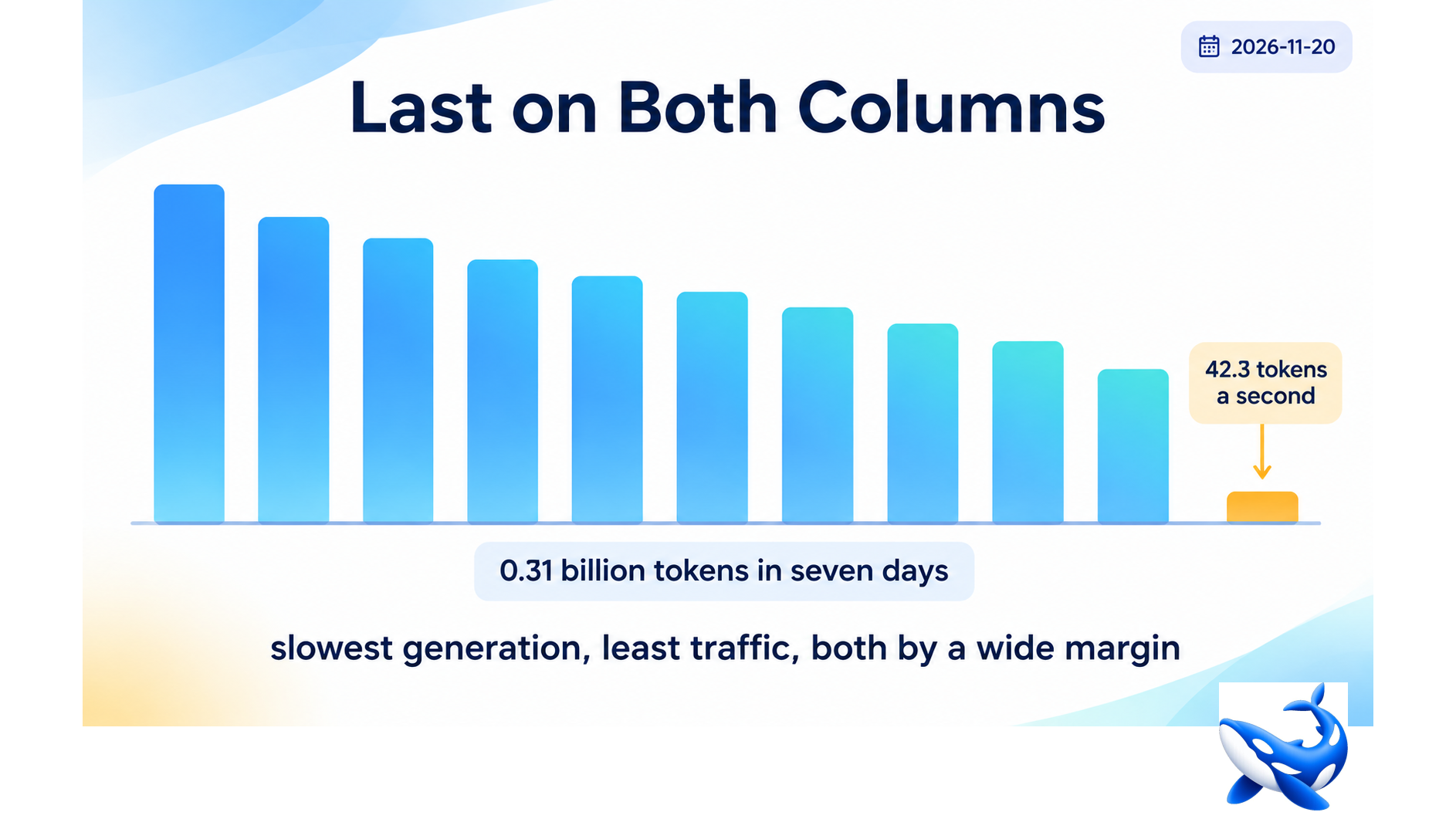
Forty-two point three tokens a second is the slowest rate in the tier, and the card carrying it also carries the least traffic. OrcaRouter publishes both figures on the same card. They are on OrcaCyber MiMo V2.6 Flash throughput, and the correlation between them is the cleanest in the tier.
The two columns
| card | tok/s | 7-day tokens |
| Zero 1.0 | 240.2 | 1.47 B |
| Flash 1.0 | 210.9 | 36.72 B |
| Zero 1.5 | 195.6 | 19.51 B |
| Hy4 Flash | 182.1 | 1.01 B |
| Hy4 | 135.1 | 12.79 B |
| MiniMax M3.1 Flash | 110.3 | 1.71 B |
| Ultra 1.0 | 109.2 | 4.20 B |
| GLM 5.3 | 91.6 | 6.37 B |
| Qwen3.8 Flash Next | 91.0 | 1.44 B |
| K3.1 Pro | 81.4 | 24.23 B |
| GLM 5.3 Flash | 66.4 | 5.42 B |
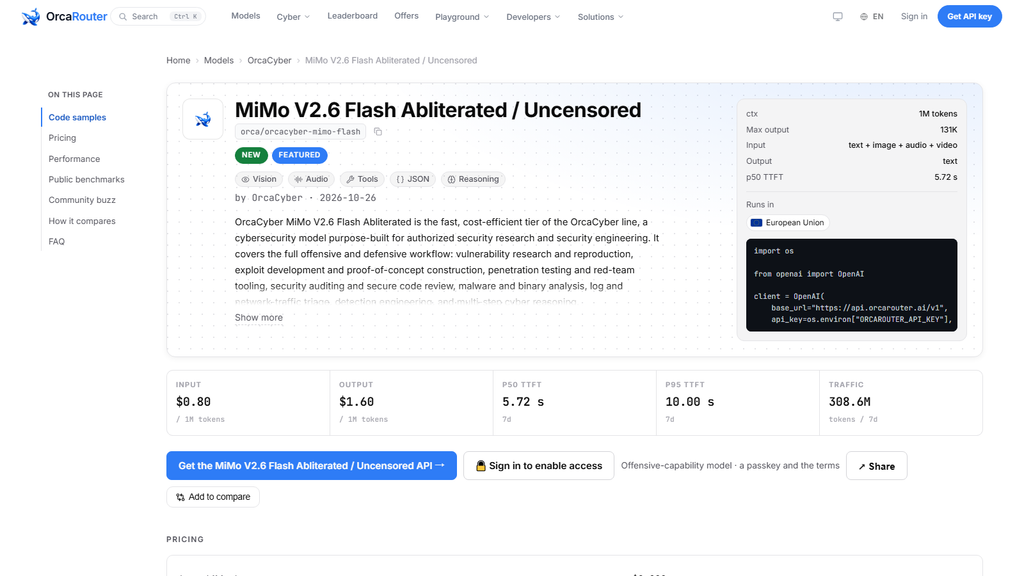
| MiMo V2.6 Flash | 42.3 | 0.31 B |
The ordering is not monotonic — K3.1 Pro is slow and busy, Zero 1.0 is fast and quiet — but the extremes line up. The slowest card has 119 times less traffic than the busiest, and the two cards under 70 tokens a second are the two with the least traffic apart from each other.
Six cards share this card’s $0.80/$1.60 price row. If price decided allocation they would split the band’s 58.39 billion tokens evenly, at 9.7 billion each. They do not: the split runs from 36.72 billion to 0.31 billion, a factor of 118.
Throughput explains more of that spread than anything else published. The fastest card on the band has 36.72 billion; the second-fastest 12.79; the slowest 0.31.
What 42.3 tokens a second does to a job
| quantity | value |
| output tok/s | 42.3 |
| ceiling | 131,072 |
| fill | 51.7 min |
| 4,000-token answer | 1.6 min |
| $/M/s | $0.03783 |
| median p50 | 5,757 ms |
| implied median answer | 244 tokens |
A 51.7-minute ceiling run is the second-longest in the tier behind K3.1 Pro’s 193.2 minutes on a ceiling seven times larger. Nothing else comes close: the next-longest at comparable ceiling size is GLM 5.3 Flash at 32.9.
Fifty-two minutes exceeds most function-as-a-service limits, every standard HTTP client timeout and most streaming connection lifetimes. A caller wanting a maximum-length answer needs a queue, a poll loop and a retry policy.
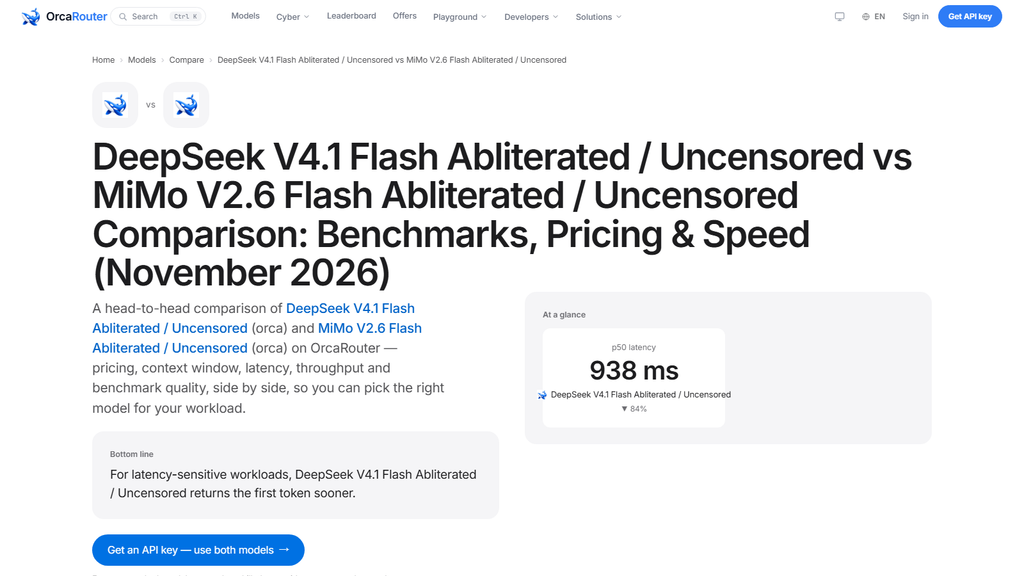
At realistic answer lengths the card is fine. A 4,000-token response takes 1.6 minutes, which fits comfortably. The published median implies a typical answer of about 244 tokens, which at this rate is under six seconds of generation — the 5,757 ms first-token wait is the larger half of the experience.
So the card is slow in a specific way: it starts late and finishes slowly, and both penalties only bite on long outputs.
The cost per unit of speed
| card | blend | tok/s | $/M/s |
| Hy4 Flash | $0.1228 | 182.1 | $0.00154 |
| Flash 1.0 | $1.0000 | 210.9 | $0.00759 |
| Hy4 | $1.0000 | 135.1 | $0.01184 |
| MiniMax M3.1 Flash | $1.0000 | 110.3 | $0.01450 |
| Qwen3.8 Flash Next | $1.0000 | 91.0 | $0.01758 |
| GLM 5.3 Flash | $1.0000 | 66.4 | $0.02409 |
| Zero 1.0 | $4.1250 | 240.2 | $0.03122 |
| MiMo V2.6 Flash | $1.0000 | 42.3 | $0.03783 |
| Zero 1.5 | $4.1250 | 195.6 | $0.03835 |
| GLM 5.3 | $3.5000 | 91.6 | $0.05458 |
| K3.1 Pro | $2.7500 | 81.4 | $0.06140 |
| Ultra 1.0 | $6.2500 | 109.2 | $0.09160 |
At a band price and the tier’s slowest rate, this card lands at $0.03783 per million per second — above Zero 1.0, which charges four times as much per token.
That is the arithmetic point worth carrying. Within the band, speed is free to choose and the spread is 5.0× between this card and Flash 1.0. A buyer who picks this card over Flash 1.0 pays the same per token and gets a fifth of the throughput.
The card’s bill for the week was $308 on 308 million tokens, a direct consequence of a $1.00 blend and a volume equal to its bill in millions.
The capabilities that might explain it
A card can be slow and still be chosen, and this one publishes two things its band siblings mostly do not.
| field | MiMo V2.6 Flash | band comparison |
| input modalities | text, image, audio, video | only card in the tier with audio |
| window | 1,048,576 | shared with five band cards |
| ceiling | 131,072 | shared with three band cards |
| parameters | 20 | band range 17 – 22 |
| CyberGym | 95.1 | highest of the three cards that publish it |
| Terminal-Bench 2.1 | 87.6 | second behind Flash 1.0’s 90.6 |
The audio row is unique in the tier. No other card lists audio input, and a caller transcribing a recording has no alternative here.
The CyberGym row is the highest among the three cards publishing it — 95.1 against Flash 1.0’s 88.1 and Hy4 Flash’s 81.1. A card scoring highest on the tier’s most-quoted security test while carrying the least traffic is a mismatch worth naming rather than explaining.
Neither capability is needed by most buyers. Audio input and a 95.1 on CyberGym both matter to specific workloads, and those workloads are evidently not the ones generating volume.
So the low traffic is not a verdict on the card. It is the visible result of a narrow fit, and the published fields say exactly which niche it fits.
Where the audio row changes the arithmetic
One modality no other card accepts can matter more than a throughput column, and this card is the tier’s only test of that.
| pipeline | without this card | with this card |
| record → transcript → analysis | two services, two bills | one call |
| measurement error | introduced at the transcript step | not introduced |
| added latency | the transcription service’s | none |
| added per-token cost | the transcription service’s | none |
| throughput penalty | none | 42.3 tok/s |
The right-hand column is worse on one row and better on four. For a pipeline that genuinely ingests audio, that is the whole decision.
For a pipeline that does not, the left column does not exist and the card’s 42.3 tokens a second is simply the slowest rate in the tier at a band price.
That either-or is why the card’s traffic is 0.31 billion tokens. A unique capability with a narrow audience produces exactly this: low volume, no substitute, and no way to grow by being better at what everybody wants.
The published fields make the trade visible rather than arguable. The audio row is on the card, the CyberGym row is on the card, and the throughput and price are on the card. A buyer with audio in the pipeline and a buyer without it are reading the same fields and reaching opposite conclusions, both correctly.
The traffic figure also carries a caveat about age. This card shipped 2026-10-26, so it has had twenty-five days to accumulate volume against Flash 1.0’s twenty-eight — a difference too small to explain a factor of 118. So the volume gap is a property of the card’s fit rather than of how long it has been on sale, which is the opposite of the situation Hy4 Flash is in.
OrcaCyber MiMo V2.6 Flash generates at 42.3 tokens a second — the slowest rate in the tier — and carries 0.31 billion tokens against Flash 1.0’s 36.72 billion on an identical price row, a factor of 118.
Its 51.7-minute ceiling run is the second-longest here, and at a band price its $0.03783 per million per second exceeds Zero 1.0’s despite Zero charging four times per token. It is the only card in the tier accepting audio input, and its CyberGym score of 95.1 is the highest among the three cards publishing that test.
Sourcing note: the throughput, price rows, window, ceiling, input modalities, parameter count, token volume, latency percentiles and four benchmark rows are read from the OrcaCyber MiMo V2.6 Flash model API and card page on orcarouter.ai on 2026-11-20, with traffic, latency and throughput being OrcaRouter production telemetry for the seven days to that date. The prices per unit of speed, fill times and band splits are our own arithmetic at a 3:1 input-to-output mix. All benchmark scores are vendor-reported. OrcaCyber MiMo V2.6 Flash is published as an abliterated model. No competitor product is named or compared. Checked 2026-11-20.